Monday, February 13, 2012

Charle's d'Orleans - The Romantic Duke


One of the earliest Valentine's ever wrote for which we still have a record of was by the Duke of Orléans, Charles Valois.

Charles was born in Paris in November 1394 and became the Duke when his father, Louis, was murdered on the orders of John, Duke of Burgundy, a rival nobleman. His childhood was full of culture and wealth, and he spent his early years in the beautiful Loire region of France. Both his parents, Louis, and Valentina Visconti, supported his education.

Charles is best remembered as a poet, writing over 500 poems. Most of these were written when he was a prisoner of war.

Charles was 14 when his father passed and he became the Duke. He was young and impressionable, and fell under his father-in-law's influence, the Count of Armagnac.

Charles's first wife was Isabella of Valois (a daughter of French King Charles VI) He loved her dearly, but she died in childbirth. In 1410, he married Bonnie d'Armagnac, Count d'Armagnac's daughter.

In 1415, Charles was taken a prisoner of war in the Battle of Agincourt. He was 21. Henry V of England took him to the Tower of London were Charles composed most of his poetry. Charles was in captivity for over 24 years (he was in the line for the French throne and England didn't want to give him up.) With nothing better to do, Charles wrote.

Most of his poetry was for his wife, Bonnie, but she died before he was released. He was let out in 1440 at the age of 46 and married a third time. His son from his third marriage, became Louis XII. His poems are mostly French Rondeaus, a two line rhythm and are usually about love and the spring time.

Upon returning to his life in France, Charles showed himself to be an able administrator and a good politician.

Charles's Valentine in the original French:

Je suis desja d'amour tanné,
Ma tres doulce Valentinée

Rondeau VI, lines 1-2.

Here's another of Charle's poem in English:


(To his Mistress, to succor his heart that is beleaguered by jealousy)

Strengthen, my Love, this castle of my heart,
And with some store of pleasure give me aid,
For Jealousy, with all them of his part,
Strong siege about the weary tower has laid.

Nay, if to break his bands thou art afraid,
Too weak to make his cruel force depart,
Strengthen at least this castle of my heart,
And with some store of pleasure give me aid.

Nay, let not Jealousy, for all his art
Be master, and the tower in ruin laid,
That still, ah Love! Thy gracious rule obeyed.

Advance, and give me succor of they part;
Strengthen, my Love, this castle of my heart.

FIND ME ON THE WEB AT:
WEBSITE:
http://www.stephanieburkhart.com

YOU TUBE:
http://www.youtube.com/user/botrina?feature=mhee

TWITTER:
http://twitter.com/StephBurkhart

MY BLOG:
http://sgcardin.blogspot.com

FACEBOOK:
https://www.facebook.com/pages/Stephanie-Burkhart-Author/149938795021166

GOOD READS:
http://www.goodreads.com/author/show/4031660.Stephanie_Burkhart

Wednesday, February 1, 2012

Release Day! AN INHERITANCE FOR THE BIRDS, Regency Comedy


My latest Regency comedy novella, An Inheritance for the Birds, the next entry in The Wild Rose Press's Love Letters series, is now available. All the stories start with a letter that changes the hero's and heroine's lives. Mine is a letter about an inheritance, but there's a catch...

Available at The Wild Rose Press.

BLURB:


Make the ducks happy and win an estate!

Mr. Christopher "Kit" Winnington can't believe the letter from his late great-aunt's solicitor. In order to inherit her estate, he must win a contest against her companion, Miss Angela Stratton. Whoever makes his great-aunt's pet ducks happy wins.

A contest: What a cork-brained idea. This Miss Stratton is probably a sly spinster who camouflaged her grasping nature from his good-natured relative. There is no way he will let the estate go to a usurper.

Angela never expected her former employer to name her in her will. Most likely, this Mr. Winnington is a trumped-up jackanapes who expects her to give up without a fight. Well, she is made of sterner stuff.

The ducks quack in avian bliss while Kit and Angela dance a duet of desire as they do their utmost to make the ducks--and themselves--happy.

EXCERPT:
Yawning, he shut the door behind him. Enough ducks and prickly ladies for one day. After dropping his satchel by the bed, he dragged off his clothes and draped them over the chair back. He dug a nightshirt from the valise and donned the garment before he blew out both candles.

Bates had already drawn back the bedclothes. The counterpane was soft under Kit's palm, and covered a featherbed. He grinned. By any chance, had they used the down from the pet ducks to stuff the mattress and pillows?

After tying the bed curtains back, he settled into the soft cocoon and laced his fingers behind his head. Tomorrow, he would have it out with Miss Stratton about the steward's residence, but that was tomorrow. He fluffed up his pillow and turned onto his side…

"QUACK!"

A bundle of flapping, squawking feathers exploded from the depths of the covers and attacked him. Throwing his arms over his head for protection, Kit fell out of bed. He scrambled to his feet and bolted for the door, the thrashing, quacking explosion battering him. A serrated knife edge scraped over his upper arm. "Ow!" Batting at the avian attacker with one hand, he groped for the latch with the other.

The door swung open. Miss Stratton, her candle flame flickering, dashed into the chamber. "Esmeralda, you stop that right now!"

The feathered windstorm quacked once more and, in a graceful arc, fluttered to the floor.

Kit lowered his arms and gave a mental groan. A duck. He should have known.

Thank you all,
Linda
Linda Banche
Welcome to My World of Historical Hilarity!
http://www.lindabanche.com
http://lindabanche.blogspot.com

Sunday, January 8, 2012

To Gain What's Lost out now.

Just before Christmas and while I was away on holidays visiting family, my Victorian historical novel, To Gain What's Lost, was released. I'm a bit behind telling everyone about it, so here's the blurb and cover for you all to have a look at!


To Gain What's Lost blurb.
She thinks her life has changed for the better, her dark secrets hidden, but little does she know…
The daughter of a wealthy landowner in Yorkshire, England in 1864, Anna Thornton leads a privileged life. But she is not content. She wants her life to mean something and longs to be accepted for the free-thinking, independent woman she is. When the dashing, adventurer Matt Cowan sweeps her off her feet, she thinks she has finally met her soul mate. However, he’s not the man he seems to be. After he sails for South America, leaving her behind in England, Anna discovers she’s pregnant. Heartbroken she flees her family home, determined to keep her child’s illegitimacy a secret. 

He has a few dark secrets of his own…
Brenton O’Mara is a strong, independent man who wants to make his own way without relying on his father’s wealth. He comes to Anna’s new home looking for work and convinces the reluctant woman to hire him. But Anna's wary of men, of love, and treats him as nothing more than the penniless laborer she believes him to be. Then, just when Anna seems to feel she is getting on with her new life, and Brenton believes he has a chance with her, the past rears up to confront them. Can Brenton and Anna learn to trust each other, or will they let yesterday destroy tomorrow?

To Gain What's Lost is available in Kindle format:
and paperback:

Thursday, December 29, 2011

Rites of Winter - Medieval Christmas Revels

By Lindsay Townsend
Make we mery, both more and lasse,
For now ys the tyme of Chrystymas
(From a 15th century carol)

When Christianity developed in the ancient Roman world, the winter solstice was already marked at 25th December. Followers of Mithras believed in the ‘unconquered sun’ and also held a feast-day for the sun on December 25th.

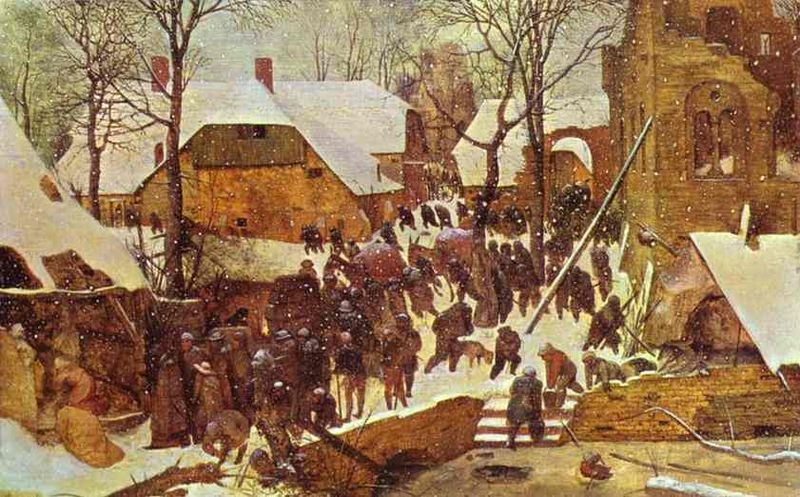
Pieter Breugel the Elder - 'The Visit of the Magi at Christmas'
The gospels did not give a date for the birth of Jesus, but ancient beliefs in the Roman Saturnalia, the solstice and sun-worship led to the church choosing December 25th as the time of his nativity.

‘Christmas’ means ‘Christ’s Mass.’ In England in the Middle Ages three masses were celebrated on December 25th - the Angel’s Mass at Midnight, the Shepherds’ Mass at dawn and the Mass of the Divine Word during the day.

Before the three masses of Christmas there was the forty days of Advent. Advent was similar to lent, a time of spiritual reflection and preparation for the coming of Christ. Feasting and certain foods such as meat and wine were meant for be abstained from during advent (something the evil Denzils ignore in my historical romance The Snow Bride, set at this time).

The feasting and revelling time of medieval Christmas began on Christmas Eve and lasted 12 days, ending on Twelfth Night. There was no work done during this time and everyone celebrated. Holly, ivy, mistletoe and other midwinter greens were cut and brought into cottages and castles, to decorate and to add cheer.

The most important element of the revels was the feast. Christmas feasts could be massive – Edward IV hosted one at Christmas in 1482 when he fed and entertained over two thousand people. For rich medieval people there was venison or the Yule boar, a real one, and for poorer folk a pie shaped like a boar, or a pie made from the kidney, liver, and other portions of the deer (the umbles) that the nobles did not want – to make a portion of ‘umble pie'. Carefully hoarded items were also brought out and eaten and other special Christmas foods made and devoured. Mince pies were made with shredded meat and many spices. ‘Frumenty,’ a kind of porridge with added eggs, spices and dried fruit, was served. A special strong Christmas beer was usually brewed to wash all this down, traditionally accompanied with a greeting of 'wes heil' ('be healthy'), to which the proper reply was 'drinc heil'.

There were also other entertainments apart from eating and drinking – singing, playing the lute or harp, playing chess, cards or backgammon and carol dancing.

Presents and gift giving was originally not part of Christmas but of New Year. Romans gave gifts to each other at Kalends (New Year) as well as a week earlier at Saturnalia, and by the twelfth century it seems that children were already receiving gifts to celebrate the day of their protecting saint, St. Nicholas, and the practice soon began to extend to adults as well, initially as charity for the poor. As the Middle Ages wore on, the custom grew of workers on medieval estates giving gifts of produce to the estate owner during the twelve days of Christmas - and in return their lord would put on all those festivities.

Wes heil!

Lindsay Townsend
http://www.lindsaytownsend.net/

Saturday, December 24, 2011

Mistletoe--A Plant For All Seasons


Christmas wouldn't be Christmas without mistletoe. In the dark, cold days of a northern winter, the evergreen mistletoe, with its glossy green leaves and white berries, promises spring will return.

But mistletoe has other faces. In ancient Britain, the Druids considered mistletoe a sexual symbol. The white berries' juice resembles semen and the Druids deemed the plant itself an aphrodisiac. By extension, mistletoe became associated with love and marriage.

The tradition of kissing may come from the Nordic legend of the death of the sun god, Balder. Loki, the god of mischief, killed Balder with a sprig of mistletoe. The tears of Balder's mother, Frigga, returned Balder to life. In gratitude, Frigga kissed everyone under the mistletoe, transforming the plant's reputation from death to life. Or new life, as in fertility.

A lesser known aspect of mistletoe labels it the plant of peace. Enemies meeting under the mistletoe laid down their arms and declared a day of truce. This time provided them an opportunity to talk out their differences instead of resorting to violence. In Mistletoe Everywhere, my Regency Christmas comedy, I use mistletoe's role as the plant of peace to bring my two estranged lovers back together.

Promise of spring, fertility symbol and plant of peace--truly a plant for all seasons. Which face of mistletoe do you prefer?

Mistletoe Everywhere Available at The Wild Rose Press, Amazon, Barnes and Noble and other places ebooks are sold. See my website (http://www.lindabanche.com) for complete list of vendors.

Thank you all,
Linda
Linda Banche
Welcome to My World of Historical Hilarity!
http://www.lindabanche.com

Friday, December 23, 2011

"Thrashing" with holly branches - a seasonal cure

The holly berry that shines so red,
Once was white as wheaten bread.

The holly and the ivy are common Christmas evergreens, still used in England for decorating houses at this time of year, and featured on many Christmas cards.

But until the 20th century holly was used medicinally in the winter to "thrash" chilblains - in other words the treatment was to give the feet a whipping with this spiny bush, an uncomfortable remedy that was supposed to work better if it drew beads of blood, like the berries the tree itself produces.
Margaret Poulter, the herbalist in The Lady's Slipper may well have tried this cure on one of her patients should they have been out in the snow too long. Whilst researching the novel I had to read many herbals and books on plant medicine. In my research I often read of this same strange treatment being used for what was probably arthritis too, and an ointment was made from the berries crushed into a salve to cure 'agues'. It is interesting that most of the conditions it was supposed to cure were 'winter ailments.'

In 1653 Culpeper suggested eating fresh holly berries as a purge, and instructions from a 1694 herbal say to boil the leaf-prickles in a posset which will "wonderfully ease the Cholick" (Pechey)

Many medicines in the 17th century were based on giving the patient a remedy with similar qualities to the complaint - so prickling pains in the stomach were likely to be treated with Holly, however uncomfortable that sounds! Nowadays however, modern medical herbalists use holly very little. And I think I will definitely leave my berries for the birds!
As well as its use in medicine, holly is a wonderful wood for crafts and in the past was used for knife handles
and fan-making, it being strong and light.The wood is very fine-grained, hard, and smooth, and almost ivory in color if it is not stained.

A book I would really recommend to anyone interested in English plant medicine would be Hatfield's Herbal by Gabrielle Hatfield.

 The name Holly derives from the Anglo-Saxon holegn and Old High German Hulis both of which mean "holy".


Thus throughout Europe holly was believed to have sacred or magical properties and bringing holly branches into one's house in winter was supposed to ward off evil and bring good luck.Holly wreaths were also given as gifts during the Roman festival of Saturnalia, which is believed by many to be the festival from which Christmas was originally adapted. It was long regarded as unlucky to leave holly wreaths up beyond Twelfth Night so they are disposed of on New Year's Eve.Although Holly is associated with winter fire it is considered unlucky to burn sprigs of holly. I guess the one on top of the Christmas pudding must be the exception!


You can find out more about Margaret Poulter the herbalist, known also as a 'cunning woman', and her search for a successor to her craft in The Lady's Slipper.
'Her characters are so real that they linger in the mind long after the book is back on the shelf. Highly recommended.'The Historical Novels Review
'Top Pick!' RT Book Reviews
'Women's Fiction at its best' History and Women
'Brilliant saga' Romance Reviews today
'Rich and haunting' Reading the Past
'Utterly captivating' Karen Maitland, author of The Owl Killers
'Riveting narrative'
For the Love of Books


Thank you for reading and A Very Merry Christmas Everyone. 
Don't forget to come back tomorrow for Linda Banche's post about Mistletoe and the Regency Period.


Thursday, December 22, 2011

Peter Alan Orchard - 'The Painter of Lemnos'

The new story follows Kindulos, a painter from Bronze Age Lemnos in the Aegean. When he is forced to flee the island for fear of his life, he finds himself amongst the soldiers of Agamemnon who are embroiled in the Trojan War. But he is sent back to the island, with a mission...

The Painter of Lemnos (c.12,000 words) is $1.99.

Buy from:

Smashwords  Diesel  Apple iBooks  Kobo  Barnes and Noble


EXCERPT:

The dog was barking. The yelping filled the roof space and bounced off the walls of the houses on the street below. It brought Kindulos tottering to his feet, clawing at his ears with both hands and desperate for peace.

It was morning and a thin, grey light washed over the harbour. One of the ships, a broad-hulled merchantman, its square sail lowered, had been launched off the beach and rocked gently in the shallows.

The dog fell silent, its job done, its eyes bright with unfocused satisfaction. In the courtyard below Kindulos and the dog, a thin elderly man stood with the stub of a torch.

'Have you seen him, Senefu?'

'Seen who?'

'The runaway. Had his brother killed, that's all I know. The word's gone round since yesterday.'

'Word from where?'

'From his village, up the coast. The king's making a gift to the Akhaians again, so there's wine coming from all over. One of them probably passed it on, the wine people.'

Senefu began to laugh, a sound like jackals fighting. 'And they told you, Kratas? A miserable, cheating piece of rubbish like you?'

'I live up the road, my friend,' said Kratas evenly. 'I was sent round here. That's all. Other folk went other ways. No-one likes a man who cheats the gods or fratricide, and this one's both.'

'No.'

There was silence for a moment or two, then Kratas mumbled, 'He's a painter, the man. Walls. Flowers and stuff.'

Kindulos lay down flat on the roof and froze to the stone. Not a word, Senefu, he begged in his mind. Not a word.

'No-one here, Kratas,' Senefu said.

'If you -'

'Don't wag your finger at me. I've seen no-one. Off you go, Kratas. No fun for you here.'

The dog set up a low, determined growling and Kindulos heard Kratas leave. The dull red of his torch brushed against the grey of the street and was gone.

A few moments later Kindulos heard footsteps on the stairs and Senefu's head appeared over the parapet.

'Leave,' he said. 'Now.' Apologetically he turned his palms upwards. 'If you're the one he's looking for, which I think you are, you have to leave the city. Every damn fool with a weapon will know who you are. No painter will be safe, no outsider will be safe and I won't be safe. That old rat wanted to get me out of this house years ago - don't ask, it's not your business - and finding you here would have the mob at my door.'

'So why protect me?'

'I'm not protecting you, I'm getting rid of you. If you're not here, you never came here.'

There was a ripple of sound up the street. From somewhere in the distance came shouting, wheezing and the rattle of hooves on the stones. Kindulos shrank down behind the parapet.

'Calm down, ' Senefu said. 'It's donkeys with cargo. There are ships leaving with supplies for the Akhaians, so the king's sending wine over to the leaders. Keep them drunk, keep them friendly, keep them on the plain outside Ilion.'

Kindulos stood up again, his decision made. 'Then the wine will come from all over the island and no-one will notice a stranger. Back up down the steps, Senefu. I'm going with them.'


Peter
http://www.peteralanorchard.net/
http://twitter.com/peteraorchard

Saturday, December 17, 2011

Northumberland for Christmas!

Why not visit the Northumberland Border country this Christmas? FAIR BORDER BRIDE is up for sale on Amazon Kindle at $3. Here's a link to the book trailer: http://www.youtube.com/watch?v=Nyui1kfCd_8

5.0 out of 5 stars A compelling, page-turning historical romance, 22 Nov 2011
By N. Steven-fountain "Lorna Mack"
Jen Black has crafted a compelling love story set in a time and place of which little is known but about which I was left both informed and wanting more. The historical detail takes you back to 1543 from the very first page. Vivid characters spring to life and you are there with them among the market stalls. You can smell the aromas, feel the fabrics, hear the voices and sense the undercurrents and attractions emerging between the protagonists. A tender, believable love story develops and on the final page you are left feeling slightly bereft as when any terrific story ends.

5.0 out of 5 stars A beautiful bride in a turbulent country..., 31 Oct 2011
By Lindsay Townsend (Yorkshire, UK)
From its fast-paced, compelling opening, 'Fair Border Bride' is an exciting historical romance set in the border lands of northern England in 1543. The romance of Alina and Harry is full of incident and tenderness and is a well-told story, with moments of humour, sensitivity and passion. They are sympathetic, rounded people and believable in their dilemmas and conflicts. The other characters in the novel are also very well-drawn, and the whole is filled with fascinating historical detail about a part of England that is rarely explored in Tudor historical fiction. If you want to lose yourself in vivid adventure and romance, I have no hesitation in recommending this novel by Jen Black.

Blurb: Harry is working for his father, the Deputy Lord Warden of the West March, and adopts the alias Harry Scott. Unhappily, Alina’s father is at feud with the entire family Scott,and flings Harry into the dungeon at Aydon Castle and threatens him with the Leap next day. Alina creeps out of her bed to visit Harry at midnight when the castle is quiet.
Short Excerpt:
“Tell me,” he said, before he forgot all practical things in the delight of her presence. “Your father threatens me with something called the Leap. What is it?”

“She dipped her head, and he heard her sharp intake of breath. “It’s the ravine, Harry.” She pointed towards the dark bulk of the hall. “On the other side is a ravine. It is deep, with the Ay burn at the bottom. Father…he makes prisoners jump from the precipice outside the hall.”

“Ah.” He raised her knuckles to his mouth, and kissed them to dispel the shadowy presence of Death looming in the darkness behind him. He remembered looking into the ravine the night he rode up here. His tongue probed the cleft between her fingers. She gasped. Harry’s blood sang through his body, and he kissed her knuckles again. “How deep, do you think?”

“Twenty times the height of a man, they say.” She shivered and frowned as she watched him nuzzle her fingers. “There are rocks and trees…”

“And no one survives?”

Her face crumpled. “Oh, Harry, sometimes they do, but they are broken, twisted creatures—”

A deep voice sounded from above, and Alina flung up her head. “Matho, please!”

Matho must have agreed, for she turned back to Harry. Her hand had warmed in his and when he kissed it once more, her other hand snaked through the bars and stroked his face, crept to the back of his neck.

“Ah, Alina,” he murmured. “Would that we had no iron bars between us.”

His flesh hardened. If this was his last night on earth, he wanted some pleasure to beguile his thoughts. He reached both hands through the grill and drew her close against the iron bars and in truth she was not reluctant, even when his hand roamed beneath her cloak, caught a ribbon and her nightgown gaped from neck to waist. His palm found the firm weight and curve of her breast and nestled around it.”

Jen Black


Monday, December 12, 2011

Christmas in Andalucia

One of the joys of living in Spain is that there's
less commercial fuss made about Christmas, or Navidad as the Spanish call it. There will be twinkling lights, and pontsettias everywhere, and some shops may play Jingle Bells and have a tree. But Christmas itself is fairly low key.

The Nativity scene ‘Nacimiento’ can be seen in plazas in most small towns as well as many Spanish homes and shop windows, often rather splendid. December 24, Nochebuena, is when the main Christmas meal is taken, often roast lamb or suckling pig, a feast that takes place quite late, as in all Spanish fiestas, starting around 10 p.m. and going on until the small hours. Some families will sing carols around the nativity scene which remains without the baby until the stroke of midnight. Others go to midnight Mass ‘La misa del Gallo’, or ‘Rooster Mass’, so named after the bird who announced the birth of Christ. Sometimes, there will be a live Nativity scene, with actors and actresses playing the parts of Mary and Joseph.

Many people, of course, like the rest of us, just watch the Christmas programme’s on TV while enjoying the traditional Turrón (nougat) marzipan, or mantecas (a range of butter-based biscuits) with Cava.

January 6th, Three Kings Day
Traditionally Spanish children do not get their presents on Christmas Day from Santa Claus, or Papa Noel, as he is called. They have to wait until the Fiesta de Los Reyes. What we would call Epiphany. By now we’re packing our Christmas decorations away, but the Spanish are still partying.

In the run up to the 6th of January, children can meet the wise men at some department stores and tell them what they would like for Christmas, just as our children tell Santa Claus.

On the 5th, the excitement starts in the late afternoon or early evening when there is often a parade through the streets of camels, yes, real ones, carrying the three kings, Melchor, Gazpar and Baltasar, who throw sweets into the watching crowds. A custom that no doubt started in Moorish times. A whole procession of dancers and musicians, trailers and even floats, will follow.


Children run around with their little bags catching their gifts. Everyone is having fun, and there are jesters and
medieval market stalls, even ducks and geese for sale.


The little girls dress up in their flamenco dresses, little boys as kings or drummer boys. And the shops remain open until after midnight.

A lovely family day. Truly a sight to see.


Before going to bed the children leave their shoes on the door step so that the Kings will know who to leave presents for. Some Spanish families are starting to put presents under a Christmas tree, perhaps because there are too many to put in a shoe. And just as British children leave a mince pie and a drink for Santa and his reindeer, Spanish children also put out something to eat and drink for Melchor, Gaspar, and Baltazar, and water and grass for their camels.

The children wake in great excitement the next morning to find their presents. For breakfast or after lunch, families eat the typical dessert of the day, the ‘Roscón de los Reyes’.

This is a large ring shaped cake or sweet bread that is decorated with candied fruits, symbolic of the emeralds and rubies that adorned the robes of the three kings, sometimes a gold paper crown is often provided to decorate the cake. Hidden inside it are surprises ‘sorpresas’. The one who finds the lucky prize is King or Queen for the day while he who ends up with the unlucky bean is expected to pay for next years Kings’ Cake – and they are not cheap!

And so another day of feasting commences. January 7 is a very quiet day in Spain. No businesses open, everyone at home in recovery.

Feliz Navidad to you all.
Freda
http://www.fredalightfoot.co.uk

Sunday, November 27, 2011

Facts and Helpful Hints from the Regency Era


 Regency intrigue novella, LOVE AND WAR is now priced at 0.99c on Amazon.com.

The Fashions
Regency gowns were influenced by the Napoleonic era, and were Classical in style. By 1816 waists were at their highest under the bust, gradually dropping until the 1830s, when they took on the style of the Victorian era, as sleeves and skirts became fuller.
The Architecture
Neo-Classical Houses were influenced by Classical Greek and Roman architecture

Stourhead, Wiltshire
Italian Renaissance
Deepdene, Surrey rebuilt in 1769-75 for Charles Howard 10th Duke of Norfolk. drew inspiration from the Palladian style of Classical architecture in the Renaissance era. 
During the 16th Century, Venetian architect, Andrea Palladio was most influenced by the Ancient Greek and Roman’s classical temple architecture. In 17th Century Europe, Palladio's interpretation of this classical architecture was adapted as the style known as Palladianism. It continued to develop until the end of the 18th century. The style influenced many of the great houses of Britain. Its Doric columns, pediments, symmetry and proportions are clearly evident in the design of many modern buildings today.

Inigo Jones was the designer of the Queen’s House, Greenwich, begun in 1616, the first English Palladian house.
                                                   The Interiors and the gardens
Stourhead library.
View of The Turf bridge from the Grotto at Stourhead

 
Helpful hints:

The Mirror of Graces (1811) By A Lady of Distinction
A Wash to give Lustre to the Face
Infuse wheat-bran well-sifted, for three or four hours in white wine vinegar; add to it five yolks of eggs and a grain or two of ambergris, and distil the whole. When the bottle is carefully corked, keep it for 12 or 15 days before you make use of it. 

Carriage and Demeanour
'Many of the naturally most pleasing parts of the female shape have I seen assume an appearance absolutely disgusting; and all from an outre air, vulgar manners, or hoydenish postures. The bosom, which should be prominent, by a lounging attitude sinks into slovenly flatness, rounding the back and projection the shoulders!'
The Waltz.
'But with regard to the lately-introduced German waltz, I cannot speak so favourably. I must agree with Goethe, when writing of the national dance of his country, "that none but husbands and wives can with any propriety be partners in the waltz.'

LOVE AND WAR
Selena couldn't accuse him of paying her Spanish coin! Gyles Devereux made it clear he had no wish to marry at all but was constrained by his circumstances. She could not be expected to keep refusing Lord Devereux, she thought crossly. She was only flesh and blood after all. What woman on earth could resist the pleas of a man such as Devereux?  
Excerpt:

At her sister, Anne's, insistence Selena found herself at the Upper Assembly rooms in Bath again the first Monday of the following month. It was crowded and she danced every
dance, but when she settled among the potted palms with a glass of detestable Madeira that a young man had brought her, she admitted to herself she was bored to distraction.
Her friend and companion on these occasions, Elsbeth, was away nursing a sick relative and Selena had never been very good at small talk with bare acquaintances. She loved to
plunge into a brisk, political debate with someone of an opposite view, or discuss the latest news of the Duke of Wellington's exploits in Spain, when news finally reached them. She liked to be busy, washing the dogs or riding in the park, and was also quite content to spend an afternoon reading a book that pushed the boundaries of her knowledge. But to sit here and simper and curtsy and dance one interminable dance after another was a bore.
She was pondering the possibilities of declaring a headache and retiring early, when a voice above her said, "Well, if it isn't Miss Selena Wakefield."
She knew that deep, amused voice before she looked up. She could scarcely raise her head as her heart began to beat unnaturally fast.
"Lord Devereux," he said unnecessarily, as he bowed over her hand.
"I may not be in the first flush of youth, Lord Devereux, but there's nothing wrong with my eyes or my memory."
"Indeed. You are remarkably well preserved. Not a gray hair to be seen, for what, three
and twenty?"
"Last Tuesday."
"Then please accept belated birthday wishes. May I join you?"
"Certainly."
He sat next to her on the small settee, his proximity making her heart beat faster. "I didn't
know you liked Madeira."
"I don't."
"Allow me to get you a glass of wine." He gestured to a waiter.
"I would be grateful, thank you."
He fixed her with a blue-eyed stare. "You are looking well."
"Thank you. And so do you." She wished her heart would slow a little from its relentless
pounding. He wore his golden hair long, tied with a black, velvet ribbon, while other men
wore theirs short and carefully windswept. It was like him to defy the popular mode of dress. His black coat of superfine needed no padding at the shoulder, fitting tightly around his
slim waist. His waistcoat was also black, as were his satin breeches. His cravat pin was his only adornment. He stood out in a crowd of glittering jaybirds, a blond devil, no doubt
secure in the knowledge that women would fall under his spell. Realizing she was also on dangerous ground, Selena steeled herself to remain indifferent to his charms, but her
heart didn't seem to be listening.
"I don't like that pasty color on you, though," he said. "It's quite the wrong green for you."
She drew a sharp breath as she smoothed the skirt of her white muslin gown, woven and trimmed with pale green.
"Oh?"
"I'm sorry, but you know I'm inclined to blunt speaking," he confessed, not looking the slightest bit sorry. "You should wear a green that matches your eyes." He touched the emerald pin glowing among the folds of his white cravat.
"This green would be perfect."
"I am as yet unmarried, Lord Devereux," she managed to splutter.
"Oh right. Insipid colors for the virginal," he said. A wicked gleam came into his eyes. "I have an excellent plan that will take care of both these problems."
She gasped and looked around. "I refuse to listen to it, Lord Devereux. You are not to be encouraged. You shall ruin my reputation. It doesn't matter about yours. It is already lost."
"Come out onto the terrace where no one will hear us."
"I will most certainly do nothing of the kind!"
He put his hand on her arm. "Curse it, Selena. I will behave myself. I give you my word. I need to talk to you."
Selena looked around. It wouldn't do to be seen shrugging him off. "I shall give you five minutes, but I can't imagine there's anything you want to say to me. We've said it all
before."
They took a turn about the terrace, passing other couples enjoying the mild evening air. Braziers burned in their sconces along the wall. Strains of the Sussex Waltz with flute
and violin floated through the open doorway. Lord Devereux's features, lit by moonlight, were classically handsome, a noble forehead, high cheekbones, a straight nose, and a mouth and
dimpled chin that made a woman weak in the knees. He settled against the balustrade beside her with a casual grace that never seemed to desert him. His heavy-lidded eyes
gazed down into hers. It should have been breathtakingly romantic and for a brief moment, it was.
"Selena, I must marry for money," he said bluntly.
She turned away, feeling he'd grasped her heart and squeezed it.
He reached out and gripped her arm, his fingers burning into the flesh between her glove and capped sleeve. "Don't go yet, Selena. I know I'm too direct. I can't be dishonest with
you. Don't know why."

"That's the nicest thing you've ever said to me," she said dryly.
He gave a brief laugh. Taking her by the shoulders, he searched her face. "I have no
desire to marry. Don't doubt I should make a very poor husband. In my defense, I'll never
consciously be cruel to you, and can offer you a title that goes back to the Norman Conquest. And by way of consolation, I like you."
"And desire my fortune."
He shrugged. "Halcrow Hall is falling into disrepair and its lands lie fallow. My great, great grandfather lost a considerable amount of money when his ships were sunk during England's war against Spain. The family fortunes have been dashed on the rocks ever since. I can't bear to see it happen, Selena."
She drew breath at the fire and passion glowing in his blue eyes. It wasn't for her, but she still found herself helplessly caught up in it. All her resolve and her commonsense failing
her like a fortress falling in battle. "You now intend to devote your life to restoring the mansion and its lands?"
"Yes. I must pay off my father's creditors," he said simply.
"I've sold out of the army, and am now living on borrowed time."
"Why now?"
He shook his head and grinned. "I turned twenty-nine and wanted to live beyond thirty."
"I must say I'm surprised they let you while the war is still raging," she said.
His blue eyes searched hers, for a sign, no doubt, that she wavered.
"Why me? There are other heiresses. Pretty ones."
"I'll be damned if I'll get leg-shackled to a shallow bore or a long-nosed, humorless wench." He opened his eyes wide.
"Or a blue stocking!"
She laughed. "Not all of them, surely."
He shook his head. "I've looked them all over, believe me.
You're the only one I could consider spending any time with."
"Well at least you don't pay me Spanish coin."
He grinned. "And many men do?"
"I have had my fill of suitors. My sister Anne is determined to have me married off before the year is out."
"Then marry me, Selena. Say you will."
She could not be expected to keep refusing him, she thought crossly. She was only flesh and blood after all. What woman on earth could resist the pleas of a man such as
Devereux? The last of the fortifications around her heart gave way.
"We might arrange a marriage of convenience, of sorts, I suppose," she said cautiously. It would certainly get the pesky matchmakers and fortune hunters off her back and
provide her with a home of her own. She refused to consider what her real reason might be, to see his face at breakfast every morning. A thought struck her. Would she be leaving
her tidy, organized life for one of hellish proportions?
"Don't think I'll live with you without the pleasures of the marriage bed," he warned, breaking into her thoughts.
"Oh! Do hush, my lord." Her face grew hot and she glanced around. Another couple stood at the end of the terrace engrossed in their own conversation.
"I wanted to make that plain."
She suppressed a shiver of anticipation as his strong, agile body leaned towards her. She found herself wondering what he looked like naked, the feel of his skin, the muscles and
bones beneath. The tautness of a male body against the softness of hers.
She swallowed. "Then ask me properly." Had she gone mad? This was a recipe for a broken heart if ever there was one.
As Lord Devereux sank down on one knee before her, an exclamation of delight came from the woman at the other end of the terrace.
If only you knew, Selena thought.
"Miss Wakefield, will you do the honor of becoming my wife?" he said in a throbbing accent, making her want to giggle. "I shall cherish you for all the rest of your life. Should
dissipation not carry me off before you," he added wickedly.
"I will. Now please get up," she said, "before we become a spectacle, and have the gossips chattering for months."
He rose and took her by the waist pulling her to him, his musky scent enveloping her. "They will anyway. Let's seal it with a kiss." He brought his mouth down on hers before she
could protest, probing with his tongue and rendering her shocked and breathless.
"Oh! That's so romantic," the lady said to her companion.
Devereux drew away. When she could find her voice, Selena said weakly. "You promised to behave."

Costume in Detail 1730-1930 Nancy Bradfield
England's Lost Houses, Giles Worsley, Aurum
Georgian House Style Ingrid Cranfield David & Charles Ltd. 1997
Louis Hellman Architecture for Beginners 1986.
The Mirror of Graces (1811) By A Lady of Distinction
Images from Wikipedia

Sunday, November 13, 2011

Old, but not out!

A lovely write up about two of my earlier books, Kitty McKenzie and it's sequel. It's so lovely to see when someone enjoys my stories!
http://aussiebookreviews.aussieblogs.com.au/2011/11/08/anne-whitfield-kitty-mckenzie-and-kitty-mckenzies-land-review-by-kelly-mclean/


Suddenly left as the head of the family, Kitty McKenzie must find her inner strength to keep her family together against the odds. Evicted from their resplendent home in the fashionable part of York after her parents’ deaths, Kitty must fight the legacy of bankruptcy and homelessness to secure a home for her and her siblings.
Through sheer willpower and determination she grabs opportunities with both hands from working on a clothes and rag stall in the market to creating a teashop for the wealthy. Her road to happiness is fraught with obstacles of hardship and despair, but she refuses to let her dream of a better life for her family die. She soon learns that love and loyalty brings its own reward.


Kitty McKenzie path has taken her from the slums of York to the inhospitable bush of colonial Australia. Yet, when she believes her dreams will never be attained, she is shown that sometimes life can be even better than what you wish for.
1866.
Kitty McKenzie is gifted land in the far north of New South Wales. Life at the northern property is full of hardships as she learns how to become a successful landowner.
However, Kitty’s strength of will and belief in herself gives her the courage most women of her time never realize they have. A decided thorn in her side is the arrogant and patronizing Miles Grayson, owner of the adjourning run. He wants her gone so he can have her land, but he wants her even more.

Available in paperback and Kindle from Amazon sites.

Saturday, November 5, 2011

Guy Fawkes Night


Remember, remember the 5th of November
Gunpowder, treason and plot.
I see no reason that gunpowder treason
Should ever be forgot.

The British celebrate Guy Fawkes Night, also called Bonfire Night or Firecracker Night, on the evening on November 5. Compulsory until 1859, Bonfire Night was one of the holidays observed in the Regency.

Guy Fawkes Night marks the failure of the Gunpowder Plot of November 5, 1605. On that night, King James I was present in Parliament when a group of Catholic conspirators, including Guy Fawkes, were caught with barrels of gunpowder in the basement of the building.

This foiled attempt to blow up Parliament and assassinate the king was a reaction to the persecution of Catholics under James I.

Anti-Catholic sentiment ran high at the time, and the Gunpowder Plot served to increase a hatred of Catholics that lasted over two hundred years. Parliament passed punitive laws that remained on the books well into Victorian times, although restrictions had eased somewhat by the Regency. For example, in the Regency, Catholics could serve as officers in the Army and Navy, where a hundred years earlier, they could not. They were allowed to attend classes in the universities, but were denied degrees. A Catholic peer could not sit in the House of Lords until 1870.

Festivities include shooting off firecrackers and burning a "guy", an effigy of Guy Fawkes, on a bonfire. Since November 5 coincides with the end of the harvest, Guy Fawkes Day contains some elements of harvest festivals. The firecrackers are probably a reference to gunpowder, but bonfires are a feature of Samhain, the ancient festival celebrated on October 31 and which is the precursor to modern Halloween. As the Samhain bonfires scare away specters and goblins, the burning of the guy symbolizes the defeat of the treachery of the Gunpowder Plot.

Some superstitions remain. One states that Parliament will not open on November 5, although the 1957 session did. And superstitious or not, the Yeoman of the Guard does a traditional search of the Parliament basements in one of the ceremonies before each session begins.

Thank you all,
Linda
Linda Banche
Welcome to My World of Historical Hilarity!
http://www.lindabanche.com
Pictures from wikipedia. Top image is an etching of Guy Fawkes Night on Windsor Commons, 1776