Showing posts with label medieval. Show all posts

Wednesday, May 6, 2015

OUT TODAY - Valens the Fletcher and His Captive by Lindsay Townsend


Valens the Fletcher and His Captive (MF)
by Lindsay Townsend
Medieval Captives 2

Siren-BookStrand, Inc.

Heat Rating: SENSUAL
Word Count: 23,476

Historical


Now with money off!


Katherine has been let down by men before. Can she trust the man who captures her?


England, Summer 1132

Valens is an arrow-maker and spy for Lord Sebastian (the hero of Sebastian the Alchemist & His Captive, Medieval Captives 1). His beloved sister Julia has died, leaving an infant who needs breast-feeding. Valens is still single, so needs to find a wet nurse for the baby.

He kidnaps young Katherine, and her baby, Jack, from a camp of women. Can Katherine save Edith, Valens’s little niece? Can she trust the handsome Valens, share her secrets, make a life with him? Can she recover Jack’s lost inheritance?

Ordered to court Katherine by his lord, Valens slowly begins to understand that he loves Kate, that he loves making a family with her, Jack, and Edith. Does his realization come too late? When, on their wedding day, a plot between Valens and Sebastian is revealed, can Katherine forgive Valens? Can she trust a spy?


A BookStrand Mainstream Romance

Chapter 1

England, Summer 1132

Valens heard the girl he had chosen as booty before he saw her. Crawling beneath the luxuriant low-hanging hazel branches and over the stinging nettles and ruthless brambles toward the women’s summer camp, he heard her weary, patient whisper. “Come on, Jack, feed for me, sweetheart. That’s right, that’s right. Good boy…”
There was a mewling whimper and the soft sound of suckling. Valens took a chance and raised his head.
Here she is, my little mother.
She crouched, half-facing away from him and behind the other women, on the less favored side of their hissing fire. Her face remained in shadow and he watched her hands, cradling, soothing, coaxing. A spit and flare from the flames illuminated her charge, Jack.
Her son, I think, or the son of her heart. Whichever the babe was, Valens took in his rounded limbs and downy head with pleasure. The infant was well cared for and the girl would care for Julia’s child—She will if she wants her own brat to thrive.
Valens lowered his wiry frame back into the crush and scratch of brambles and allowed the wet nurse’s soft crooning to wash over him.
“You are doing so well, my pretty darling, growing so big and strong. Let me check your padding…Good boy! I have more wool tufts and moss in my pack. Soon you will be clean and dry again, my Jack…”
The girl had been saying similar nonsense over the past four days that Valens had been tracking the women’s camp. So far he had only approached this close to her after twilight, content in the day to shadow the group at a distance. With her hair hanging limply ‘round her face in greasy, dirty-blond curtains, he still did not know if the wench was as pretty as a beech nut or as ugly as a gall apple, but her hands were clean and deft and her clothes patched and tidy. Baby Jack had more things than she, with three carrying slings and a half dozen little cloaks and hoods.
She may not wash her hair but she cares for Jack and will be a fine wet nurse for Edith. Valens frowned and tried not to think of his dead sister and her ailing child, in case a passing devil caught his feelings and made them worse, but it was no use. Julia had passed away seven nights ago and he and his widowed father were struggling with their grief and with Edith, Julia’s child. At almost two years old, Edith was beginning to eat more solid food, but it was the custom to breast-feed until two years, and weaning itself was dangerous. He and his father Thorkill, Edith’s granddad, had no idea what to do, beyond treating the grizzling infant like a sickly calf. Julia’s child was not thriving and would not do so until he could supply breast-milk by means of a wet nurse.
His present duty, to spy on the goose herder women, had proved provident. Accepting the task from his lord, Valens had known that such bold females would have youngsters and babies and one of the women would be in milk. Lucky for me. Julia would have said it was God’s will, but Valens was less sure, seeing that God had stolen Julia from him. He knew that tiny, squalling Edith would not make up for the loss of his sister, but the child was a part of Julia, one he vowed to preserve.
“You are not getting her,” he vowed under his breath, not caring who he meant at that moment, God or the devil.
He felt breath on his neck and twisted ‘round. The scowling face of his lord loomed briefly, then Sebastian crawled to one side, cursing at this cramped spying place.
“Only you, runt, dare have me scramble this way.”
Valens acknowledged the grumble with a flash of teeth. “But always worth it,” he countered, ignoring the taller man’s nickname. No one but Sebastian dared to comment on his lack of height, so he reckoned they were even.
“Are they thieves?” Sebastian jabbed a long, pale fist at the camp. His blue eyes darkened as Valens gave a brief nod. “Explain.”
Used to the man’s brusque orders, Valens counted off on his fingers. “One, they are meant to be goose herders but they have no geese.”
“This close to Michaelmas? They should be thigh deep in fattened-up birds, driving them to market.”
Valens grinned afresh. Sebastian was always quick, it was one reason he spied for the man. That, and he paid in gold, on time. “Two, they have clubs and ropes, lots of ropes.”
“For restraining prisoners and hostages. Go on.”
“Three, they are practiced in pretending to be fluttery, foolish maidens. A well-set-up traveler rides through the forest on one of the main trails and these women are there, arranged like a Mystery play, all tasteful sprawled limbs, big eyes, and pleading glances.‘Oh, kind sir, can you help us?’ and more of the same, till the fool steps down from his horse and they have him.
“Four—”
“I can count.”
The warning made Valens skip to his greatest news. “Big Agnes is their leader.”
In the dark blue twilight Valens almost missed Sebastian’s thin mouth tightening, but he heard the satisfied, “A name worth gold. Our sheriff has wanted her for some time.”
“Where is Julian?” Valens whispered, checking on the girl again as she rubbed her baby’s tiny back.
“Swirling somewhere in that red cloak and being heroic, no doubt.”
A prickle of alarm sped down Valens’s spine. “Not here, I hope. That cloak and that yellow hair of his, they will show up.” He dismissed the rest of Sebastian’s sour comment. His lord was touchy about his looks—though far less since his marriage—but Julian was something else. Even Valens, who also liked women, could see that.
There was a low snort from the hazel thicket, as Sebastian stifled laughter. “Peace, man, the sheriff is not an idiot. He does not go to your lengths, but he knows how to blend in woodland and so do his men.”
Valens forbore to comment that he dyed his red hair black so as to blend in, as Sebastian put it. His bushy and above all bright mane was distinctive, and for a spy that was bad.
“We attack them tonight?” Sebastian asked.
“Early morning is better. We shall see more and the women are slow to shift. Several have children.”
“By Lucifer, another problem,” muttered the man beside him. “My men will not like that. I do not like it.”
“I think you will have little trouble,” Valens said quickly. “Such women with youngsters are low status, like camp followers. They earn their keep by washing and cooking and are kept away from the main leaders. A few strikes on a shield will have them scattering and their brats with them.”
“Runaways and strays, eh? They will not be harmed. And where is Big Agnes?”
“Sprawled, with her flagons, right by the main fire with her cronies, dividing up the day’s takings. They are usually half-drunk in the morning, still.”
“Better, by Lucifer.” Sebastian clapped him on the shoulder, the closest his lord would come to outright approval. “And what do you want for your work?”
Valens showed his teeth at his lord’s scowling face and pretended to consider. “Four days and nights squatting in holly bushes, covering my tracks, going without food or more than a sip of ale. What would you say to granting me a holiday, my lord?”
Sebastian wormed backward and Valens followed. Skirting a flowering and spiky wild rose that showed blue in the late evening light, the men crawled behind the cover of a beech tree and stood upright.
“Ask again, master fletcher,” Sebastian said then. “I need those arrows of yours.”
Valens shook his arms and legs to get the blood flowing again. “Well, then.” He braced himself, aware his next request would most definitely not be approved. “I want a girl from the camp.”
 Sebastian dragged him off his feet and hoisted him aloft as if he weighed no more than a leaf. Half-choked by his tunic, Valens sucked in air and kept talking.
“Not as my slave but to help! The wench will have a better life with me than cast adrift.”
His lord’s eyes glittered. “You will marry her?”
By Adam, he is wed and now thinks every other man should be.
“If she is a widow, then yes.” Resentment sharpened Valens’s answer. “I need a wet nurse for my sister’s child, not a bed-mate. Put me down.”
“Or what?” Sebastian chuckled and lowered him. “I should call you Cuchulainn after the Irish warrior. He was a runt, too.”
“Everyone is short to you,” Valens muttered, slipping his knife back into its sheath as he was released. Not that he did not trust Sebastian, but spying kept his reactions honed. The dagger had been in his fist and pricked against the taller man’s belly before he had even thought of it. He had no idea who Cuchulainn was and did not care. “Are we agreed?”
Stepping back, Sebastian glared down his long hooked nose and gave him a searching look that made him feel like a new apprentice with his master. “You will keep her and her infant safe?”
“I will,” vowed Valens, thinking of Julia and Edith.
“Snatch them tonight, then, and take them away with you.”
Valens gave a brief but wide smile. His lord had given him something else with this, the chance to spare the girl and her babe the panic of an attack. “I intend to. Let me have two men.”
Sebastian folded his arms across his chest. “You want to terrify mother and child?”
“Two good men,” Valens persisted, ignoring his lord’s mocking glower, the dark humor in those dark eyes. “Two good men to show her the futility of struggle. I’ve taken down knights in full armor before now, so a girl and a baby will be easy.”
“Very well.” Before he moved back in the direction of the camp, Sebastian touched his arm. “Be careful,” he warned. “Too much…trouble and the girl might lose her milk.”
“I have my ways,” said Valens, with a confidence he did not altogether feel. Sebastian was still glowering down his nose, though, so all must be right with the world.
“Keep safe, runt.” His lord seemed on the verge of saying more, but instead clapped him on the shoulder for a second time.
“And you, my lord.”
The two men parted ways.

* * * *


Katherine could not shake the feeling that she was being watched. Worse, that she and Jack were being watched. The other women of this camp constantly slighted her in flea-bite ways, remarking or gesturing about her small size, feeble strength, and lack of wood-craft. Big Agnes, their leader, had agreed to let Katherine travel with the gang and had then ignored her. The others—who surely were no goose herders, for where were their geese?—had copied Agnes, or Aggie, as she liked to be called. For the week Katherine had traveled with them, aside from being piled with filthy clothes to wash, she and Jack had been left alone.
It is exactly what I want, she told herself, but lately, with this constant tingle at the back of her neck and the sinking feeling in her stomach, with this sense of being watched, spied on, she was less sure.
Jack smiled at her, gummy and warm, and she was enchanted afresh. That she and Eric had produced such a wonderful, sweet, clever child she thanked Christ for every hour. Propping the bundles of clothes she had to wash in a protective circle around him, she set Jack down to roll and crawl and toddle, clapping her hands in warning each time he crept and waddled to the edge of the circle.
Her bare hands, Katherine thought with a sigh. She had sold her wedding ring nine days ago but the lack still smarted. If only Eric had not died. If only I had been more patient with him and not nagged him in our bed. That was a dark shame and secret of hers and one she still flinched from. If only my husband had kept his word and not kept all those secrets
“Hey, Wash-tub!”
Katherine refused to flinch at the hated nick-name, or at the muddy, cold scrap of cloth that slapped down the side of her face. She caught it before it fell anywhere close to Jack and heard the braying order, “Big Aggie wants that washed tonight.”
She nodded and scooped a faintly grizzling Jack into a carrying sling. Where she would find wash-water at this hour was one problem, although at a pinch she could use her own urine and rinse the scarf in—what? Rainwater collected in a tree stump?
But she did not complain. Better to be bullied here than bullied and raped at the old house by my stepson. He was starting to pick on Jack, too. Eric had sworn he had made provision for us, but he did not. Secrets, always secrets. Remembering her own secret with a shudder, she picked up her pack and the washing bundles and moved farther back from the fires, preparing to do as Big Agnes demanded.

* * * *

Spiteful fools, Valens thought, wishing he had his lord’s skill with poisons and could slip some to these chattering mares. To expect a nursing mother to leave the safety of the camp simply to wash a scarf spoke of a careless arrogance that made his blood boil. The girl and her babe would do far better with him. They do not deserve her.
He was so furious it was several moments before he could admit that their petty malice, to one of their supposed own, had made capturing his prize easier. The young woman was clearly seeking fresh water and had just found some in a moss-covered birch stump. She had placed Jack into a cocoon of bedding and was pounding the scarf on a smooth rock, stopping after each weary flick to glance to the distant camp and peer into the closer trees. Sure that his dark clothing, dyed black mop and dirt-smeared face would make him invisible, Valens slipped his sheathed knife from his belt into his boot—he did not want the girl trying to grab his blade and stab him—and waited. He moved as she did and squirmed closer to the baby.
Jack was gnawing his fist but content and eager to be diverted by the sparkling toy of a gold chain and crucifix, dragged by Valens across the rim of his circle of blankets. Gurgling, the baby obligingly tottered, then crawled on plump little legs after the pretty thing. Valens allowed Jack to grab the chain and picked up the baby, settling the child on his hip. Jack snuffled and stared up at him in wide-eyed wonder. He trusts me.
“Jack! Where are you?”
On her knees now, the woman was patting and throwing aside the empty circle of clothes, gasping in her panic. Valens loomed closer, sweating a little himself, though his voice was cool and low.
“Here with me. Shush.” He closed his other hand around his little mother’s thin wrist and yanked her to her feet, deftly releasing her and removing her eating dagger from her belt as she stumbled. She fell against him and he caught her again, winding an arm about her middle and snagging her against his body as closely as he cradled her son. Her mouth and eyes were as wide as Jack’s, but she did not scream. Her attention was altogether on another matter.
“No, Jack, not in your mouth.” She grabbed the gold chain and made a brave attempt to smile at her son. “Never something you could choke on.”
Valens released her wrist to sweep his dark cloak around all three of them. “I shall know that next time.”
“Give me my boy.” The wench reached for him but Jack nuzzled against Valens, who was in no hurry to release either of them. He leaned closer, keeping a firm hand on the baby.
“No.” Valens gambled on her not wishing to scare or hurt Jack by trying to wrest him free.
Her eyes glanced away from him and her baby to the camp. At a snap of his fingers, Sebastian’s two good men rose out of the undergrowth, taking a step closer. The woman moaned as she saw the chance of any possible escape diminishing to nothing.
“No help here or over there,” Valens spoke as if no other fate was possible. “You and Jack are coming with me.”
“Why should we?”
He liked the flash of temper. Anger meant she would not faint. This close, he saw her face for the first time, rather than her bent head or profile. He stared for an instant—he could not help it.
My little mother is a pretty waif. Not beautiful, he corrected at once, not with that grubby hair or sharp little nose, but her face was free of pox scars and had an open, impudent look. She had a narrow head and a thin mouth that curved up at the corners and green eyes that shone with fury, lightening them to the color of fresh beech leaves. He had done well for himself by her capture. To marry this will be no torment.
He inhaled sharply and smelled her sweet, milky scent, felt her turgid breasts press against his lower ribs. She was smaller, much slighter than him, but tucked nicely under his chin for all that. The realization slid through his mind as fast as an arrow bolt, then he was answering.
“I need your help.”
He had not meant to say that. He wanted to get her walking, get them farther into the trees, away from the others. “Come with me now. No trouble.”
He prodded her side with a finger and she jerked sideways, flinching as if she feared a dagger thrust. “I promise I will not hurt you or your boy,” he added.
“Such vows are easy to make,” she answered at once, reaching out again. “Give me my son.”
He prodded her shoulder. “Walk first.” He did not tell her there were horses nearby, one step at a time was enough.
Still the woman did not move. She stared at how he held Jack, balanced against his hip, and more suspicion flared in her face. “Why—”
I cannot waste more time on this. Edith is ailing. Valens scooped baby Jack into her arms and picked both of them up. Ignoring her instant struggles, he began a shuffling retreat, flanked by the two men. When the girl opened her mouth to yell, he silenced her by pressing his lips onto hers.
Refusing to acknowledge either the guards' knowing smirks or the blistering agony when the annoying, squirming, necessary wench bit him, he staggered deeper into the forest.
How had he ever thought this would be easy? Once I have them back at home, it will be.
He could only hope.


Valens the Fletcher and His Captive is book 2 of my Medieval Captives Series. Book 1, Sebastian the Alchemist and his Captive, is already out.


He takes her for hate. Will he keep her for love?

Sebastian, lord of the tower in the northern high lands, is a proud, bitter man with a dark past. An alchemist and a warrior, he has had lovers but knows he is ugly—experience and betrayal have taught him that.  When Melissa, the beautiful, neglected daughter of two old enemies, falls into his possessive hands he is determined to hold her. Why?

As one of the detested and defeated Felix family,  Melissa must cling to her courage when she is claimed as a war-prize by the tall, grim Sebastian. Expecting torture and ravishment, she finds instead a peace and sanctuary that she has never known. Treated with kindness for the first time in her life, Melissa begins to blossom.

But there are secrets and old betrayals between them. Sebastian’s abiding jealousy is not easily quelled, especially when someone at the tower seeks to destroy his growing love with Melissa…

Medieval Captives 1

Read Chapter One 


OUT NOW FROM BOOKSTRAND, AMAZON, BARNES & NOBLE AND OTHER SELLERS

BOOKSTRAND

AMAZON COM 

AMAZON UK

BARNES & NOBLE 

KOBO

APPLE


Saturday, December 7, 2013

Medieval Christmas Gifts, then and now

During the Middle Ages, Christmas was seen as a sacred time, the time for the three Christ-Masses. Charitable giving to the poor was encouraged on Saint Stephen's day, December 26, which we know as Boxing Day.  On Boxing Day in the middle ages, the poor received money in hollow clay pots with a slit in the top, nicknamed 'piggies'. Unlike modern piggy banks, these clay pots had to be broken to extract the cash.

A page from the Bedford Hours.
What about gift-giving among other classes?

Sacred gifts - of prayer books and so on - were seen as being appropriate for the holy Christmas period. Anne of Burgundy presented the Bedford Hours to Henry VI, her eight-year-old nephew, in 1430. The book is now at the British Library.

Gifts were sometimes given at the New Year. New Year's day, known at the time as the étrenne, a word derived from the Latin strena,  (used to mean both the gifts and the ritual exchange) was the traditional time to do so. Gifts might be food -Christmas was a time of feasting and, for example, it was considered bad luck to refuse a Christmas mince pie given by a host. A Christmas kiss of peace might be given under the green kissing bough of holly and other green-stuff and mistletoe, the plant of peace. Sometimes the 'gift' might be a joke, such as the 'book' given by the illuminators of Les Tres Riches Heures to the Duke de Berry, which turned out to be a block of wood. 

At times the gifts were part of very formal processions and ceremonies. At the courts of Henry Tudor and Richard II the king rose on the day of the New Year and seated himself in his chamber ready to give and receive presents, given and received in strict order or rank. Sometimes the heralds and messengers bringing such gifts could also find themselves rewarded, as happened in the court of Richard II when the carver of the King was given a gold cup by the French King Charles. Kings and Queens could exchange gifts, often of rich jewels, as a public show of respect and affection. Rulers were expected to be generous but at the same time the size and value of gifts were ranged in order of class - kings and queens, their families, nobles, servants, right down to laundresses and cleaning-women. In some years, certain symbols might be used in gifts. In 1422 at the court of Charles VI, small jewels shaped like peacocks were given out to courtiers -  the peacock being one of Charles's badges. 


In medieval England, such gift-giving also went on. People gave New Year’s gifts to those above and below them in the social hierarchy. For example, peasants who worked on landed estates brought gifts of farm produce to the local lord during the Twelve Days of Christmas. Custom dictated that the lord respond by inviting them to a Christmas feast. Personal gifts between people of equal status might have taken place but there are few records of such. In the records and for many kings and nobles, gift-giving meant ostentation and display.

Christmas and gift-giving features in several of my books:

'The Snow Bride' is a Winter Solstice and Christmas story, less than £2 or $3 on Amazon. You can read the first three chapters here.

A lighter-hearted read, still concerned with Christmas and gift-giving, is my medieval fantasy, 'A Christmas Sleeping Beauty.' This is half-price at Muse it Up.

'Twelve Kisses' touches on a young newly-married couple in early Tudor times and their first Christmas together. This is also half-price at Muse it Up.

All this didn't start in the Middle Ages, naturally. The Roman mid-winter festival, Saturnalia, had its own range of festivities which feature in my Flavia's Secret.

Lindsay Townsend

Friday, November 15, 2013

A Witch in Medieval England - Lindsay Townsend

Witches, in a series of sketches attributed to
Pieter Breughel (or to Hieronymus Bosch)
(Source: Wikimedia Commons).
One of the difficulties of considering the situation of witches in medieval England is the sources. Most of our information comes from trials in clerical or secular courts, and often these were motivated not by fear of sorcery but by greed, spite and politics. In England some kings feared witches – or found that accusing former mistresses or wives of witchcraft was an easy way to dispose of them, much as later Anne Boleyn was accused of sorcery by her disgruntled husband Henry Tudor.

These events were partly high politics. What of the position of witches in more everyday, village settings?
One clue comes from the folklore surrounding plants. Peonies, rowan and St John’s Wort, for example, were believed to protect households from sorcery, which shows how much witches were feared. At the same time, there were those men and women, known in many part of England as ‘cunning folk,’ or ‘wise men/women,’ who were turned to for help in fortune telling, charming and healing.

In the Middle Ages in England everyone was a bit of a witch because everyone believed in magic, often as a curious blend of pagan, folk and Christian ideas. Peasants would chant the Lord’s Prayer over their penned cattle each night, ending with singing ‘Agios, Agios, Agios’ around them every evening as a piece of protective magic. A mixture of charms and prayers were used to solve all manner of problems, and ranged from curing toothache by appealing to the Lady Moon and then praying, to the Anglo-Saxon prayer-charm ordering the devil of pain to flee 3 times and give way to Christ. 

Rowan, a protection against witches.
Nobles had magic gems and amulets to protect them from evil.  A medieval  ring discovered at the Palace of Eltham, Henry VIII’s childhood home near London, was set with ruby and diamonds and carried an inscription promising the wearer luck. Merchants also had  gems and rings to protect themselves, much as people in modern times might wear a St Christopher to give them luck on a journey.  A burglar would  throw a crushed magnet over hot coals to inspire the household  to leave and let the thief work in peace. Priests would use blessings and  prayers such as the Lord’s Prayer and add a charm or two to effect an exorcism or expel illness.  Even the legends of saints have them using charms and magic to cure ills. When all sickness was seen as the result of evil, then it made sense to use ‘good’ magic to counter it.

If a man had to go to court, he might tuck a spray of mistletoe into his clothes to ensure he was not convicted. If he wished to inflame a woman’s lust, then he could slip some ants’ eggs into her bath. However, there were times when such simple ‘magic’ might not work (believe it or not) and people would seek out a recognised practitioner of magic.

To raise the dead or a demon needed a person skilled in rituals, who knew Latin, Greek, writing, astrology and fumigation and many of these necromancers were ex-priests or clerics. Some could be involved in the dangerous business of assassination by magic. In 1325 the necromancer  John of Nottingham was accused of taking money in return for killing the king by making a wax effigy of  Edward II and sticking pins into it. John was acquitted.

For love magic, however, and to inspire or stop affection, most people turned to their local ‘cunning folk’, especially the local midwife/healer or perhaps a white witch - who would use magic and witchcraft to good ends and within a Christian setting, using prayers as well as charms. These people could be both feared and revered  and were vulnerable to being accused of evil-doing if a person or animal fell sick. 

Throughout the Middle Ages good witches were mostly tolerated in England. It wasn’t until 1401 that the first act of parliament against witchcraft was passed. If a person was convicted of witchcraft, it was regarded as a form of heresy and the offender was excommunicated. In 1438, Agnes Hancock was excommunicated by a clerical court when she could not account for the meanings of some of the words she used in her love charms. The church took a dim view of love spells, feeling that they interfered with people’s free choice, but it wasn’t until the late Middle Ages or beyond that women casting such spells were threatened with burning.

If you are interested in learning about an English medieval ‘good’ witch in a fictional setting, please see The Snow Bride and its sequel,  A Summer Bewitchment.

Sunday, February 26, 2012

Inspired by fairy tales

I’ve always loved fairy tales: African fairy stories, Old Peter’s Russian tales, Grimm’s fairy tales and the western classics – Cinderella, Sleeping Beauty, Beauty and the Beast, The Goose Girl, The Frog Prince. The themes of love, sacrifice, keeping promises (the theme of the Frog prince) transformation (in The Goose Girl and Cinderella) justice (again in Cinderella) are epic to me and timeless, worthy of exploration in romances and modern stories.

Cinderella, the story of selfless devotion rewarded, is a popular theme for many romance stories, with the ‘prince’ often an Italian or Arab billionaire who sweeps in to transform the heroine’s drab, oppressed life. I’m sure there are romances to be written about the ugly sisters, too – positive stories where they grow from their petty spitefulness and obsession over balls and dances into generous, complete women, who also find love. That element of the happily ever after and the unexpected is strong in both fairy tales and in romance and both appeal to me greatly.

Fairy tales can also be epic, dealing with issues of life and death. Look at Gerda and her determination to win her brother out of enchantment in The Snow Queen. Look at Sleeping Beauty, where the prince rescues the princess from the ‘death’ of endless sleep.


Recently I did my own ‘take’ on Sleeping Beauty in my ‘A Christmas Sleeping Beauty’. I made it a story of transformation for both my heroine, Rosie, and the prince Orlando, who starts as a very arrogant and selfish young man who needs to learn to love and cherish. I didn’t want my Rosie to be passive, simply waiting to be woken, so she is active in the story both through her dreams and through her speaking directly to the hero in a letter. I also added more urgency by making it a ticking clock story – Orlando must wake Rosie in three days or he loses his chance forever.

The story of Beauty and the Beast has thrilled me since I was a child, with its dark and menacing beginning, the terrifying beast and Beauty’s courage and love for her father and ultimately for the beast. I was inspired by these basic tenets to write my own medieval version of Beauty and the Beast in my ‘The Snow Bride’. Magnus, the hero, has been hideously scarred by war and looks like a beast. He considers himself unworthy of love. Elfrida, my heroine, is also an outsider since she is a white witch, but she willingly sacrifices herself (as Beauty does in the fairy story) because of love, in her case her love for her younger sister, Christina, for whom she feels responsible. When she and Magnus encounter each other, I made it that they could not understand each other at first, to add to the mystery and dread – is Magnus as ugly in soul as in body? They must learn to trust each other, despite appearances, and come to love (just as in the original fairy tale).


I also added other fairy tale elements to ‘The Snow Bride’: magic, darkness, the idea of three (a common motif in fairy tales) spirits in the forest and more. Perhaps in the darker elements of my forest I was inspired by that other old fairy story – Red Riding Hood.

How about you? What inspires you in your reading or writing?

Lindsay
http://www.lindsaytownsend.net
http://www.twitter.com/lindsayromantic

Thursday, December 29, 2011

Rites of Winter - Medieval Christmas Revels

By Lindsay Townsend
Make we mery, both more and lasse,
For now ys the tyme of Chrystymas
(From a 15th century carol)

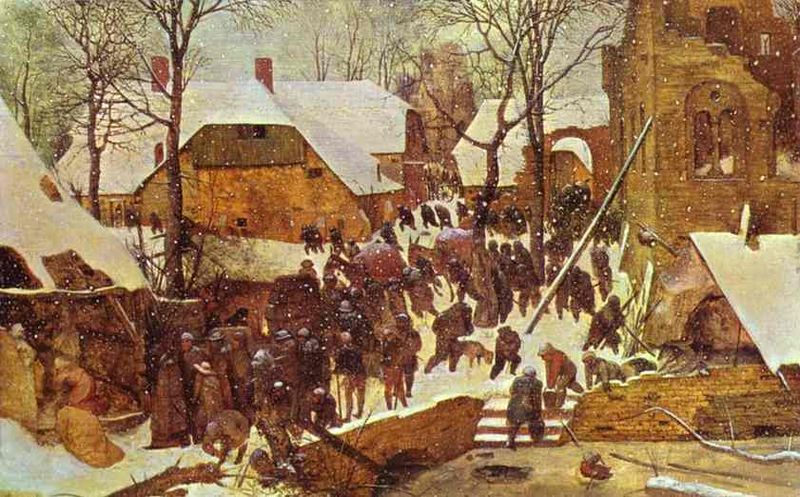
When Christianity developed in the ancient Roman world, the winter solstice was already marked at 25th December. Followers of Mithras believed in the ‘unconquered sun’ and also held a feast-day for the sun on December 25th.

Pieter Breugel the Elder - 'The Visit of the Magi at Christmas'
The gospels did not give a date for the birth of Jesus, but ancient beliefs in the Roman Saturnalia, the solstice and sun-worship led to the church choosing December 25th as the time of his nativity.

‘Christmas’ means ‘Christ’s Mass.’ In England in the Middle Ages three masses were celebrated on December 25th - the Angel’s Mass at Midnight, the Shepherds’ Mass at dawn and the Mass of the Divine Word during the day.

Before the three masses of Christmas there was the forty days of Advent. Advent was similar to lent, a time of spiritual reflection and preparation for the coming of Christ. Feasting and certain foods such as meat and wine were meant for be abstained from during advent (something the evil Denzils ignore in my historical romance The Snow Bride, set at this time).

The feasting and revelling time of medieval Christmas began on Christmas Eve and lasted 12 days, ending on Twelfth Night. There was no work done during this time and everyone celebrated. Holly, ivy, mistletoe and other midwinter greens were cut and brought into cottages and castles, to decorate and to add cheer.

The most important element of the revels was the feast. Christmas feasts could be massive – Edward IV hosted one at Christmas in 1482 when he fed and entertained over two thousand people. For rich medieval people there was venison or the Yule boar, a real one, and for poorer folk a pie shaped like a boar, or a pie made from the kidney, liver, and other portions of the deer (the umbles) that the nobles did not want – to make a portion of ‘umble pie'. Carefully hoarded items were also brought out and eaten and other special Christmas foods made and devoured. Mince pies were made with shredded meat and many spices. ‘Frumenty,’ a kind of porridge with added eggs, spices and dried fruit, was served. A special strong Christmas beer was usually brewed to wash all this down, traditionally accompanied with a greeting of 'wes heil' ('be healthy'), to which the proper reply was 'drinc heil'.

There were also other entertainments apart from eating and drinking – singing, playing the lute or harp, playing chess, cards or backgammon and carol dancing.

Presents and gift giving was originally not part of Christmas but of New Year. Romans gave gifts to each other at Kalends (New Year) as well as a week earlier at Saturnalia, and by the twelfth century it seems that children were already receiving gifts to celebrate the day of their protecting saint, St. Nicholas, and the practice soon began to extend to adults as well, initially as charity for the poor. As the Middle Ages wore on, the custom grew of workers on medieval estates giving gifts of produce to the estate owner during the twelve days of Christmas - and in return their lord would put on all those festivities.

Wes heil!

Lindsay Townsend
http://www.lindsaytownsend.net/

Monday, October 10, 2011

Magic and magic-makers in medieval courts

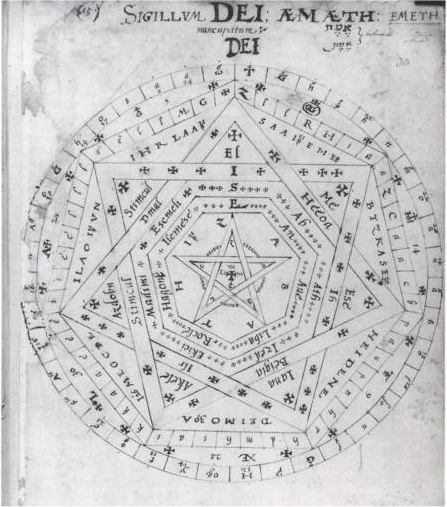
Seal from a manuscript by John Dee (sourced from Wikipedia Commons)Magic played a strange and ambivalent role in medieval society. Wise-women and wizards were sometimes tolerated or revered or sometimes persecuted as witches, particularly if their 'magic' went wrong. Yet at the same time, priests could perform magic and utter charms as well as prayers to combat evil or demons.

All levels of medieval society believed in magic, including the courts. Magicians might be employed at European courts as entertainers, as alchemists, as healers or as diviners. In the later Tudor period we have John Dee, who served Elizabeth I as her astronomer and occultist, and the alchemist and astronomer Paracelsus. In myth we have Merlin, one of the most famous magicians of them all, who was on the edge first of Uther Pendragon's court and then of King Arthur's, and feared and respected in equal measure. In France in the 14th century, the astrologer Thomas of Pisano made figures out of wax to destroy the invading English by magic.

Astrologers, alchemists and magicians, promising gold, health and power, were often welcomed at court and given high status. Yet their places were always vulnerable. Jealous rivals could accuse them of using magic in an evil way, as happed to Mummolus, a shrewd military tactician of the sixth century AD, a time when Frankish Gaul was split into several kingdoms. Accused of witchcraft by Fredegund, queen to Chilperic I of Soissons, Mummolus was tortured and died of his wounds.

In 1441 Eleanor, duchess of Gloucester, was accused of using ‘treasonable necromancy’ against King Henry VI in order to advance her husband. She was imprisoned for life, while the astrologers Thomas Southwell and Roger Bolingbroke, together with Margery Jourdemayne, ‘the Witch of Eye‘, were condemned to death. In the mid-1480s Richard III of England accused Elizabeth Woodville (previously married to a Lancastrian) of having bewitched his late brother Edward IV into marrying her.

Even the court of the medieval papacy was a place where members could be accused of magic - because magic-making was seen as a part of life and a way of gaining or keeping favours. In 1317 the bishop of Cahors was tried for using magic against Pope John XXII and trying to smuggle magical images into the papal palace in loaves of bread.

Lindsay Townsend

Saturday, August 6, 2011

Short-lived medieval fashions

For many centuries in the Middle Ages the basics of fashion for men and women remained the same - a gown for women and a long or short robe or tunic for men. Fashions for sleeves, hats and shoes could be more fleeting or even extreme and it's those I'm looking at today, particularly in Britain.

The sleeveless tunic, based on a knight's surcoat, was a popular clothing choice for medieval men. Then in the middle of the 13th century there was a brief fashion which added wide sleeves to the tunic and sometimes a hood, turning it into a garment called a gardecorps. This was intended to replace the surcoat and cloak, combining both into a single item, however it never really caught on. Still with sleeves and male fashion, the bag-sleeve for men, a wide, baggy sleeve snug at the wrist and shoulder, was popular for about twenty years around 1400, but again never really caught on.

For medieval women, hair and headdresses tended to be 'the thing'. Between 1130-50 there was a fashion for noble women to wear their hair long in plaits and for them to sheath these plaits in silk, usually white with red circular stripes. These sheaths were called fouriaux. However it was with headdresses that medieval noble-women especially indulged and which set the medieval clerics scolding about excess and vanity. A brief fashion, lasting roughly thirty years, was the heart-shaped head-dress, a headgear designed with two 'horns' on either side of the woman's head. Sometimes these headdresses became even wider, which caused a cleric of the time to remark: "She is hornyd like a kowe... for syn." At Ludlow, within the church of St Laurence, there is a misericord carved with a woman portrayed as a scold - and wearing a horned headdress. Women in later years wore the steeple headdress or hennin, a tall cone arrayed with long, flowing veils, although this tended to be a European than British fashion. This was also railed against by clerics, particularly in France.

All classes craved fashion, as can be seen by the various sumptuary laws passed in 1363 and 1463 which tried to stop 'lower' classes dressing in furs and certain fabrics and aping their 'betters'. Such acts made no difference as people loved to dress up.

Men's vanity was often shown in shoes. Piked shoes - shoes with points - were popular with men in the Middle Ages, although the length of the points varied through the years. The truly exaggerated points were a short fashion. The idea that men wore the long points with chains attached to their knees to stop them tripping up may simply have been a mistake or a later urban myth. However, such cramped shoes did cause medieval people to have real problems with their feet, similar to those found in women of the 1950s who wore pinching, pointed-toed stilettos. An archaeologist working in Ipswich found evidence in a medieval cemetery of people with painful feet as a result of their shoes.

Everyone, it seems, suffers for fashion, no matter how short-lived that fashion may be.

Lindsay Townsend
http://www.lindsaytownsend.net/
http://www.twitter.com/lindsayromantic
 
Bookmark and Share