Tuesday, March 29, 2011

Regency Hygiene, or the Lack Thereof, Part II: Beau Brummell


George Bryan "Beau" Brummell (1778-1840) almost single-handedly brought frequent bathing into vogue in the Regency. The son of a clerk, he was not particularly distinguished for his good looks, education or connection. But he was always very neat, his clothes were a masterpiece of simple elegance, and both his garments and his body were always spotless.

Brummell insisted that a gentleman be clean--clean as in total body immersion in water. His efforts succeeded in part because he had gained the favor of the crown prince, George, later the prince regent. When Brummell converted the prince, the upper classes followed, with the lower orders not far behind.

Brummell turned personal hygiene into an art form. He was famous for his daily three-hour regimen of scrubbing every part of his body, removing all the hair from his face, and then wrapping himself in immaculate, simple clothes that were the antithesis of the male fashions of the previous fifty years. Although his manner of dress was at first called "dandyism", Brummell created the masculine attire we still use today: shirt, tie, jacket and trousers, all well-tailored, on a meticulously clean body.

When he was born, the standard of male beauty consisted of a wardrobe of costly, brightly-colored fabrics, powdered hair or wig, makeup (yes the men wore makeup) and high-heeled shoes. All over a dirty body and filthy hair, both heavily doused with perfume in an attempt to mask, usually unsuccessfully, massive body odor due to infrequent bathing. See previous post.

As an example, these stills from the 2006 BBC production Beau Brummell: This Charming Man show (left), the Prince of Wales before Brummell's influence, and (right), afterwards.

Brummell was not the first proponent of cleanliness. The return to bathing had started before he was born. In the mid 1700's, Philip Stanhope, the fourth Earl of Chesterfield, wrote a famous series of letters to his son emphasizing personal hygiene. In France, Jean-Jacque Rousseau extolled cleanliness in his novel, Emile, or On Education (1762), although he personally was not that fastidious.

But the English considered anything French suspicious, and they turned to copious amounts of soap and water only when the consummately British Brummell arrived on the scene.

Brummell's story did not end happily. He fell out with his patron, the Prince of Wales. Afterwards, his gambling debts forced him to flee to France, where he spent the rest of his life. His gambling debts increased as his health declined. He died at sixty-two due to the complications of tertiary syphilis.

Today, we remember Brummell as a male fashion plate. In time, advances in science and the wider availability of soap and hot water cleaned up a world mired in dirt. But Beau Brummell hastened that day by making cleanliness fashionable.

Thank you all,
Linda
Linda Banche
Welcome to My World of Historical Hilarity!
http://www.lindabanche.com

Friday, March 25, 2011

Why not Avebury?

Photo of Avebury by Jim Champion (from Wikimedia Commons)
I've recently been watching and enjoying two UK TV series about the early pre-history of Britain (Neil Oliver's and Bettany Hughes's), and they brought back memories of stone circles. Not of Stonehenge, however, but of Avebury, where we spent some time when I was writing Bronze Lightning. I took my heroine Sarmatia to Avebury and used the powerful setting for some of the pivotal scenes in the story.

As a place Avebury remains impressive and intriguing, despite the ravages of time and the deliberate vandalism of some of the huge stones. It’s older than Stonehenge and much bigger, incorporating several circles, avenues and barrows. The ditch was dug by red deer antler picks and was 30 feet deep. Its proximity to the West Kennet long barrow and Silbury Hill, the largest man-made mound in Europe, has led some archaeologists to speculate that this is a vast ritual site.

I've noticed, though, that the star status of Stonehenge has tended to put Avebury a bit in the shade. Is it because the massive stones don't have lintels? Or because the tiny village of Avebury has grown up within the site and so it doesn't appear as broodingly untouched?

Anyway, when we were there, it seems ages ago now, there was a white pheasant squawking in the village, a flight of old Lancaster bombers flew over to mark a wartime anniversary and the chimney of the cottage had a birds' nest in it. I have a soft spot for Avebury.

Lindsay
http://www.lindsaytownsend.net/
Twitter

Monday, March 21, 2011

The King's Highway

Loaded by Jen Black

The roads in Tudor times were designed to get people to market. Where no towns existed, there were only rough tracks. Most people travelled on foot. Since fresh produce did not travel well, carts carried fruit and vegetables only short distances. Meat always travelled on the hoof, some of them great distances via the ancient drove roads.
People who were very old or ill sometimes travelled in a litter, either horse-drawn or carried by servants, but there were no coaches or carriages. The first coach in England was built for the Earl of Rutland by a Dutchman, Walter Rippon, in 1555. In 1564 he built one for Queen Elizabeth, but they were not common until the seventeenth century.
Couriers and government officials, pilgrims, scholars and merchants travelled great distances, but many English never left the parish in which they were born. Others did, and risked arrest and a flogging if they left their parish without a licence from the authorities and a good reason for travelling.
The foot traveller hoped to make twenty miles a day, and it was rare for an ordinary horseman to cover more than thirty. In bad weather, hilly or flooded country, the distance could be reduced to fifteen miles or less. Heavy wheeled carts wrecked roads and tracks alike, and without attention in a thousand years, the Roman roads were disintegrating.

During Mary and Elizabeth’s reign, some roads were paved. Four long-distance roads were maintained: The Great North Road from London through Durham, Newcastle and Alnwick to Berwick-on-Tweed, Dunbar, Haddington and on into Edinburgh. (During my childhood in Durham, Silver Street was still called the Great North Road). Watling Street ran from London to Chester, taking travellers to Ireland; Dover Road ran from Dover to London; and the great road from London to Exeter and on to Plymouth. Beyond Plymouth, the traveller went by tracks and byways.

The King’s messengers used relays of fresh horses kept at staging posts twenty miles apart on these four roads, and they covered much greater distances than the ordinary traveller. The Great North Road was one of only six north of York. One went from Newcastle to Otterburn across the Cheviots to Jedburgh. It was the shortest route to Edinburgh, but inhabited by reivers and bandits who killed and robbed on either side of the Border. The King’s Street ran north from Lancaster to Penrith and Carlisle. Two roads went from east to west – from York to Catterick Bridge and Penrith, and the Newcastle to Carlisle road through Hexham and Haltwhistle along the north bank of the Tyne. The sixth road ran from York to the port of Scarborough which carried on a busy trade with Scandinavia.
The journey from London to Edinburgh took the normal traveller fourteen days at thirty miles a day. Messengers riding post could do it in five. The seventy miles of the Dover road could be done in two days, but the fit and strong courier could do it in a day. The 215 mile journey to Plymouth took the ordinary traveller a week; couriers thirty-six hours.
By contrast, when Henry and Elizabeth travelled ‘on progress,’ they rarely covered more than ten miles a day. Henry went to France, but he never travelled further north than York, and to that city only once. But there was one good thing about the scarcity of roads: you could be reasonably sure of meeting someone on a certain road on any given day.

Friday, March 18, 2011

Charles IX of France

Writing about the Valois was fascinating as they were such a troubled family. All Catherine’s sons seemed to be blighted, probably as a result of inherent syphilis, and all suffered from consumption. Yet they were highly intelligent, well educated, and with the exception of poor Alençon, good looking. Their tutor was the Humanist Jacques Amyot. He wrote poetry and a work on hunting, and his happiest moments were when he would sit up late into the night talking to writers and musicians. On these occasions he would be entirely calm and content.

Charles IX was the most sensitive of the brothers, often emotional and easily moved to tears by a poem or a sermon. He loved hunting and all field-sports but was weak and unstable. If his wishes were thwarted by the smallest degree, his golden brown eyes would grow fierce, his manner turn brusque and uncivil, which could quickly deteriorate into a temper tantrum, often caused by jealousy of his brother Anjou.

Catherine controlled his every waking hour. The time he must rise, insisting that once in his chemise, the lords and nobles, gentlemen of the bedchamber and his man-servants should be allowed in for the King’s lever, as was the custom in his father’s day. After this came council business and dispatches until ten, when he was expected to attend Mass. A walk before dinner, which was taken at eleven, to be followed twice a week by an audience. Time was allowed each afternoon for him to ride, joust, or perform some other sport, and he was also expected to visit the Queen Mother, and the Queen his wife, according to tradition, before preparing for supper which he took with his family.

In addition, she set out careful written instructions on how he must address his councillors, what questions to ask local governors, how to organise appointments and honours and not simply give to those who begged for favours.

He was remarkably obedient and dutiful to his mother’s wishes, which was her intention, but if Catherine pressed him too far he would fall into a rage. Even Margot, who was fond of him, could not deny that he was an odd boy. He would often sink into worrying moods of deep melancholy, stay in bed all day, or be gripped by a mad frenzy when he would don a mask, waken some of his wilder friends, and, taking lighted torches, would go on a rampage around the darkened streets of Paris. They’d call on some poor unfortunate, drag him from his bed and beat him senseless, purely for the pleasure of it. Or he might turn on his dogs or horses and thrash them instead. When the lust for violence came upon Charles, there was nothing anyone could do to stop it. The mere sight of blood seemed to both terrify and excite him. I believe this flaw in him was the reason Catherine was able to terrify into giving his support to the massacre.

Catherine accepted these flaws as she did not expect the boy to live long, and in this she was proved to be correct. When Charles ultimately succumbed to the disease that had claimed his late brother, Francis II, Anjou, Catherine’s favourite, whom she loved with an almost incestuous passion, took his place on the throne.

Charles IX only mistress was Marie Touchet (1549 - 1638) He loved and remained loyal to her for all his adult life. Besides his sister Margot, she was the only person able to control his mood swings, calming him and making him warm cinneman milk as if she were his nurse.

A pretty, gentle girl from a humble backward, she was in her late teens when she first became his mistress. She was well liked by Catherine, and when Charles married Elisabeth of Austria, fortunately his new bride had the wit to accept her as Marie created no problems. In time the two young women even became good friends. Marie bore him a son, which his wife sadly failed to do, Charles de Valois, who later became the Duke of Angoulême.

After Charles’s death, Marie married the marquis d'Entragues, Charles Balzac d'Entragues, and it was her daughter, Henriette, born in 1579, who became one of Henry IV’s most notorious mistresses. I've written about her in The Queen and the Courtesan,the last in the Marguerite de Valois trilogy which comes out in hardback in September.

Scene from Hostage Queen - in which Charles IX attempts to stand up to his mother, Catherine de Medici.

When the time came for the royal party to depart, Jeanne begged the King to allow her son to stay on an extended visit, and because Charles was soft-hearted and felt sorry for a mother being separated from her son, he readily agreed. Catherine entered the chamber just as Jeanne was thanking His Majesty for the favour.

‘What is this?’ she curtly demanded of her son, eyes cold. ‘Are you now making decisions on your own account, so soon after reaching your majority?’

Panic clouded his sensitive features, and Margot, feeling pity for the over-sensitive Charles, hurried to offer him her support. ‘I’m sure it would be but a short stay,’ she said, thinking what a relief it would be to be rid of Henry of Navarre for a while.

Charles agreed and hastily added, ‘Think how distressed I should be were we to be parted, Mother? Is it not unnatural for a family to be kept apart?

Such matters had never concerned Catherine, having rarely seen her own children as they were growing up, although she had frequently asked for portraits to be painted of them so that she could check on their progress. ‘I am sure the Queen of Navarre will think so.’

The two queens faced each other, the one furious, the other defiant. They might go through the motions of good manners and diplomacy, but they remained sworn enemies. The Queen Mother feared the lesser kingdom, with it’s strong Huguenot character, might raise an army against her with young Henry at its head.
Jeanne was afraid her precious son might be turned into a papist by the influence of the French Court and its Queen.

‘Pray leave us and permit me to discuss this delicate matter with the King.'

Jeanne curtseyed, paying the homage that was due to the other, more powerful, queen. ‘As you wish, Your Majesty, but the King has promised, and I trust him to keep his word.’

Alone with her son Catherine allowed her anger to show. ‘You had no right to make a political decision without consultation. Many factors need to be taken into account, and you do not possess the experience to make such a decision.’

Seeing how her brother’s eyes rolled back in his head, always a bad sign, Margot dared to interrupt. ‘Madame, the King is not well.’

‘Silence, girl!’

Charles clung fast to his sister, hating to be scolded. ‘I can think for myself. I am not stupid. I am the King!’
Seeing that her brother was growing agitated, Margot began to stroke his hair, trying to calm him, crooning soft words in his ear.

Catherine ground her teeth in fury. ‘Of course, and are you not the cleverest of my sons?’ It was a lie, meant to pacify him. Her beloved Henri was more brilliant in every way. ‘Yet you need good counsel in order to make wise decisions. I would not have you taken advantage of by these Protestants.’

‘I have many friends who are of the new faith, and Jeanne is my aunt. I have ever had a fondness for her.‘
There was a fever now in his gaze and a foaming at the mouth as he began to chew on his fingernails. ‘I am King! I can do as I like, and I have given my word.’

‘There are times when even a king must break a promise.’

‘No, I will not, I will not!’ Then he fell to the ground and began drumming his heels in temper. Terrified he might harm himself Margot dropped to her knees beside him, desperately trying to prevent the convulsions which would surely follow. Catherine strode from the room calling for his nurse, knowing she must relent. The King had promised that the young Prince of Navarre could stay for a short holiday with his mother, and a king’s word must be kept, even though she held the power and always would.

Hostage Queen, now available in paperback and as an ebook.


For more details about my books call in at my website www.fredalightfoot.co.uk

Tuesday, March 15, 2011

A little bit about... St. Patrick


By: Stephanie Burkhart

St. Patrick was an interesting guy who helped to bring Christianity to Ireland. It's kind of hard to pin down when he was born, but it's believed he was born between 385-387 AD in Wales. He was born a pagan. When he was 16, Irish raiders kidnapped him and held him as a slave. It's believed he was held on the west coast of Ireland, near Mayo, but the exact location is unknown. While in Ireland he lived as a Shepard. It was lonely work, and Patrick turned to God for comfort. According to Patrick, God spoke to him in a dream telling him to leave Ireland. After 6 years, he escaped to Gaul where he studied and became a Christian.

In 432 AD he was called to go back to Ireland. When he returned, he helped to establish churches and schools. He used a shamrock to help teach the Holy Trinity to the people. The shamrock represented how the Father, Son, and Holy Spirit could all exist as separate elements of the same entity.

He died on 17 March 461 AD.

There can be no doubt St. Patrick left his mark on the Irish people. In 1903, Ireland made St. Patrick's Day an official public holiday.

Interesting fact: The Chicago River is dyed green in honor of St. Patrick's Day each year.

Interesting note: The shortest St. Patrick's Day parade takes places in Dripsey Cork. It's only a 100 yards (a football field!) between the town's two pubs.

Interesting myth: St. Patrick is known for driving the snakes out of Ireland, but its highly unlikely he did. The island was separated from Europe during the last ice age.

Ewww?
St. Patrick's jawbone was preserved in a silver shrine.

While there's not much Irish in my house, we have a good time being green for the day. My husband enjoys cooking a corned beef. My son, Andrew, gets into wearing shamrock socks and a button that says "Kiss me, I'm Irish." I'm a sucker for Bailey's Irish Cream & Harp.

I'd love to hear about your customs and traditions.

Let me leave you with a couple of Irish sayings:

There's no fireside like your fireside.

Good luck beats early rising.

A diplomat must always think twice before he says nothing.

Friday, March 11, 2011

A Profile in Courage - George VI


By Stephanie Burkhart

George VI was the right man for his times, but his life had never been easy despite his title. Recently, I saw the movie "The King's Speech." It is a brilliant peek into the personal courage that George VI embodied.

Born on a day full of heartache.

George VI was born on 14 December 1895, a great-grandson to Queen Victoria who was still on the throne. For Victoria, 14 December was the anniversary of her husband's death, Prince Albert. Unsure of how the Queen would take the news, George's parents offered to name their son Albert Fredrick Arthur George. Victoria was pleased. Interestingly, the Queen noted that "Bertie" as George VI was known by his family, was born on such a sad day, but was given a name so dear to her, it was a name that was great and good.

And Bertie would be a good king, despite the challenges he faced.

Bertie was the second son of George, Duke of York (George's father was King Edward VII, Victoria's son). Bertie's parents were not overly demonstrative, leaving their children to be raised by nannies. In "The King's Speech," Bertie tells Lionel of a particular bad nanny who used to pinch his cheeks and withhold food from him.

As a young child, Bertie suffered from ill health. He had to wear painful splints because he was knock-kneed and he developed a stammer. Left handed, young Bertie was forced to use his right.

These challenges only helped the young prince develop strong personal courage.

Bertie saw service in World War I as a midshipman in the Navy. His fellow officers referred to him as Mr. Johnson, in order to hide his identity and protect him. Later, he became involved in the Royal Air Force. After the war, he studied at Cambridge and on 4 June 1920, he was created Duke of York by his father, George V.

Then Bertie met Lady Elizabeth Bowes-Lyons at a children's birthday party. She gave him the glace cherry from her cake. Bertie was determined to win her heart.

While Lady Elizabeth had bloodlines going back to Robert the Bruce, she was considered a commoner by British law. Bertie pursed her wholeheartedly, but he had to buck up when she turned down his first marriage proposal. Displaying that dogged personal courage he had since birth, Bertie did not give up and finally Lady Elizabeth told him yes. They were married on 26 April 1923. In 1926, their daughter, the current Queen Elizabeth II was born.


What I find interesting about this historical tidbit, is that Bertie was given a lot of leeway from his royal parents to find a bride. Yes, Lady Elizabeth Bowes-Lyon was a commoner, but she was beloved. Queen Elizabeth II, knowing this about her parents, had still insisted her son, Charles, find a royal bride. (dare I add one that was virginal?) If she had followed her parents' example, I suspect Charles would have been as happy as his grandfather with his marriage the first time around. Now, with Prince William posed to marry Kate Middleton, a commoner, it seems the Queen has taken history to heart.

In 1925, Bertie gave a speech at Wembly in which he couldn't hide his stammer. Knowing the people expected more from the Duke of York, he sought help from an Australian born speech therapist, Lionel Logue. Lionel worked with Bertie to help him master his stutter and by 1927, Bertie spoke with much more confidence in public. Lionel kept working with Bertie through the 30's and 40's. In 1937, now King, George VI awarded Logue with the Royal Victorian Order, which recognized distinguished personal service to one's sovereign.

Bertie loved tennis and was very physically active, but he would need all his stamina when his brother, Edward VIII abdicated the throne in 1936.

Some find Edward VIII's story romantic, some find it appalling, but Bertie's older brother abdicated to marry the love of his life, Wallis Simpson on the eve of World War II.

Bertie came to the throne and styled himself George VI. He was 41. Interestingly, he had to buy Balmoral and Sandringham from his brother since they were private properties and didn't pass to him automatically.

When World War II struck, George VI displayed his personal courage once again for all to see, staying in London during the bombing raids of the Germans. London's east end was hit hard. When two German bombs exploded in a courtyard at Buckingham Palace, George stood by his wife when she declared, "I am glad we have been bombed. Now we can look the east end in the face." The couple's profile gave Britain the morale boost it needed.

Starting in 1949, George's health started to fail. The fact he was a heavy smoker didn't help. In September 1951, his left lung was removed when a malignant tumor was discovered. He died peacefully in his sleep on 6 February 1952.

While born under the shadow of sadness, Bertie and his great-grandfather, Prince Albert, shared the trait of great personal courage. (I consider Prince Albert the ultimate "beta" male – after all, he took a backseat to his wife, Queen Victoria, at a time when men should rule the marriage. This took a lot of confidence in himself and a lot of chutzpah to look his contemporaries in the face.) This courage defined them both, invigorating a nation, and proving they were the right men for their times.


About Stephanie: She enjoys history, especially British history. Some of her favorite monarchs include; Edward IV, George II, Queen Victoria, and George VI. You can find Stephanie on the web at her blog: http://sgcardin.blogspot.com or her website at: http://www.stephanieburkhart.com

Saturday, March 5, 2011

Send more socks

I lost my day planner last week, and I've been lost without it.

So lost, in fact, that I completely forgot to post my blog yesterday when it was scheduled to run. For two days, I had the nagging feeling that I'd forgotten something...and this morning I remembered what it was.
Remains of a sewer drain at Vindolana

Sigh. Does anyone else do this?

I'm not feeling particularly stressed out at the moment, but my life is cluttered with a lot of little chores and menial worries that clearly affect my brain function.

All this, oddly enough, makes me think of the letters of Vindolanda. So rather than post what was going to, I'm just going to continue with the theme of menial stressors.

My area of study was 11th and 12th century English history, but you need to learn a lot about the entire era to master a handful of decades. As a result, I studied Roman Britain extensively, and a few years ago I was able to visit the ruins and museum of Vindolanda.

Vindolanda was a Roman fort and settlement near Hadrian's Wall. Excavations have turned up a treasure trove of daily life: shoes of all shapes and sizes, utensils, and most importantly, hundreds of small wooden tablets on which letters were written. The letters include everything from a birthday invitation to a child's writing lesson to a soldier's letter home asking for more socks.

The best, though, and an example of what must of been a really big headache to the fort's commander is the one that suggests he had to submit expense reports to Rome. (Imagine having to explain your coffee and chocolate budget to Caligula--now that's a stressor!)

So what about your time period? What type of small stressors ruined their memories?


Building's foundation and floor at Vindolanda

Sunday, February 27, 2011

English Jacobites

Loaded by Jen Black

It is often forgotten that there were Englishmen amongst the Jacobite supporters who rose in rebellion in 1715. If one name is remembered, it is usually that of James Radcliffe, 3rd Earl of Derwentwater, a Northumbrian and an illegitimate grandson of Charles II on his mother's side. (Anya Seton's novel Devil Water may have brought him a little fame.) He owned huge estates in Northumberland and Cumberland, and his loyalty to the Stuarts was undisputed.

He and his brother Francis went to Saint-Germain in 1702 as companions to James Francis Edward Stuart and became ardent Catholics. His first attempt to help restore James Stuart to the throne occurred during the failed invasion of 1708, when he was unlucky enough to be captured in a French ship.

In 1709 he settled on his estates in Dilston, Northumberland, and very quickly developed a wide range of friendships among the Catholic and High Anglican gentry of Northumberland, Durham, Cumberland and Lancashire. He worked constantly to promote James Stuart’s cause and married a Catholic heiress, Anna Maria Webb, who was a devoted supporter of the exiled Stuarts.

Another key local Jacobite was William, 4th Baron Widdrington who had spent much of his youth at Saint-Germain. He lived at Stella on the Tyne, had extensive mining interests and was well known among the region's Catholic community. Both Derwentwater and Widdrington had large extended families of co-religionists across Northumberland and Durham. Other important Catholic Jacobite families were the Haggerstons, the Swinburnes of Capheaton and the Erringtons of Beaufront, near Hexham.

The Catholic families of Northumberland and Durham represented a wealthy and powerful force with considerable influence, and all favoured the cause of James Stuart.
Two local MPs, William Blackett of Newcastle and Thomas Forster of Bamburgh, though not Catholic, were deeply involved in Jacobite plots. Thomas Forster was High Anglican and Tory, and he believed that many Tories could be persuaded to come over to the Jacobite side once a rebellion had begun.

William Blackett was a successful Newcastle merchant who had bought Wallington from another Jacobite family, the Fenwicks. He was a Tory and was also a secret Jacobite. Being a successful member of the mercantile community, it was hoped he would be able to bring over the political establishment of Newcastle. These men were the ring leaders of Jacobite activities in Northumberland and Durham and were to be key players in the failed Rising of 1715.

Lords Derwentwater, Widdrington, Nithsdale, Carnwath, Wintoun, Kenmure and Nairn were impeached for high treason. Forster, John Clavering, Thomas Errington, William Shafto and eight Lancastrians were also impeached for conspiring against church and state, inciting the people and raising rebellion in Northumberland, Durham, Cumberland and Lancashire.

On 19 January all but Wintoun admitted their guilt before the Commons. Lord Chancellor Cowper asked each of the Lords if they had anything to say before sentence was passed. Derwentwater gave a strong assurance of his future loyalty and appealed to Cowper to consider his wife and children. Widdrington, Kenmure and Nairn made similar pleas.

Cowper was unmoved. All seven lords were immediately sentenced to death. The Countess of Derwentwater, together with several family members and influential friends, gained audience with the King and begged for clemency. Her heart-rending pleas were in vain, though a reprieve was offered on condition that the Earl renounced his religion and conformed to the Established Church.

Derwentwater turned the offer down down on grounds of honour and conscience. Nairn, Widdrington and Carnwath were more fortunate, being reprieved shortly before their execution. Nithsdale and Wintoun managed to escape from the Tower.
Derwentwater was led out to Tower Hill and just after midday 24th February 1716 had his head severed from his body by the axe-man. Kenmure followed him to the scaffold.

Meanwhile, in Liverpool on 12 January trials had been prepared against thirty-six Scots and thirty-eight English. Four were Northumbrians. Thirty-four of them were executed in various towns in Lancashire. They included John Hunter and George Collingwood. Collingwood's wife desperately tried to win a reprieve for him, but in spite of Lord Lonsdale's involvement, he was hung, drawn and quartered on 25 February.

Friday, February 25, 2011

The Putney Debates

By summer 1647, the Roundheads were winning the English Civil War. Oliver Cromwell's New Model Army had crushed the Cavaliers at Marston Moor and Naseby, and King Charles was in custody at Hampton Court Palace; albeit an easy captivity for he was allowed to see his children, entertain his friends, play bowls and go hunting.

At this time, the New Model Army officers, among whom were Puritans and Levellers, could see an end to their usefulness and the generals, the ‘Grandees’ feared Parliament, who, suspicious of the religious fanaticism of the army, feared they would disband them.

Keen for a final settlement with the King, Parliament also wanted to cut soldiers' pay, disband regiments, refuse indemnity for war damage and pack them off to Ireland. Worse, they looked set to betray the religious and political ideals the New Model Army had spent five years fighting for. The soldiers complained: ‘We were not a mere mercenary army hired to serve any arbitrary power of a state, but called forth ... to the defence of the people's just right and liberties.’

The ‘Grandees’ responded by inviting the Leveller Agitators to debate their proposals before the General Council of the Army at a gathering that took place between the 28th October and 9th November. With Oliver Cromwell in the chair, the New Model Army came together at St Mary the Virgin Church at Putney, in October 1647, to argue the case for a transparent, democratic state free from parliamentary or courtly corruption.

The Debates

The leading grandees were Sir Thomas Fairfax, Oliver Cromwell and Henry Ireton, The prominent Levellers were, Colonel Thomas Rainsborough, ‘Honest’ John Lilburne, Richard Overton, Edward Sexby and John Wildman.

The Issues:

- Should they continue to negotiate a settlement with the defeated King Charles I?
- Should there even be a King or a House of Lords?
- Should suffrage (a civil right to vote, known as the franchise) be limited to property-holders?
- Would democratic changes lead to anarchy?
- Would religious toleration be granted to Puritans, Quakers, Anglicans and Presbyterians?
- As King Charles made no effort to negotiate and had brought ‘foreigners’ [Scots] into the country to fight his people – what should be done with him?


Levellers

The Grandees submitted, ‘The heads of the proposals’ – a conservative document that did little to challenge the existing power structures, in effect offering to hand the crown back to King Charles with few concessions.

The Levellers offered their own manifesto entitled the ‘Agreement of the People’, which set out a constitutional settlement urging religious toleration, a general amnesty, an end to conscription, a system of laws that applied equally to everyone with no discrimination on grounds of tenure, estate, charter, degree, birth or place. They also demanded regular, two-yearly parliaments and an equal distribution of MPs' seats by number of inhabitants.

They believed in human liberty and a conviction that politicians were as dangerous as princes when it came to undermining personal freedom, and that all those who placed themselves under government should have the right to elect it.

The wealthy, socially conservative Grandees were horrified, assuming this would mean anarchy and corruption with wealthy politicians buying up the votes of the uneducated, dependent masses.

Instead, Cromwell's son-in-law, Henry Ireton, proposed that the franchise be limited to those with a ‘fixed local interest’, that is, the independent property owners.

Colonel Rainsborough declared this a betrayal of the civil war sacrifice, and finally a compromise was reached that the vote should be granted to all adult males - excluding servants, apprentices, foreigners, beggars and, of course, women.

As for the King, the mood had by this time hardened against that ‘man of blood’ and general opinion turned to putting him on trial for high treason.

The issues of the Putney Debates - liberty of conscience; a government dependent upon the sovereign will of the people; equality before the law - would, via the ministrations of John Locke, make their way into the American constitution. In Britain, these philosophies remained buried late into the 19th century mainly thanks to ASP Woodhouse's 1938 work, Puritanism and Liberty, which implicitly conjoined the struggle against fascism with Rainsborough's cry of liberty.

What the Levellers proposed nearly 400 years ago was precisely the kind of secular constitution that guaranteed freedom of conscience and speech alongside a sovereign parliament.
Why Putney?

Putney in 1647 was a small Thames-side town of about 900 people, strung out along the High Street and the river bank, with London six miles away and easily accessible by horse, coach or boat.

The inhabitants of the town no doubt bitterly resented having soldiers billetted upon them without being paid compensation. There were plenty of attractive billets for officers both in Putney and Fulham, Lord Thomas Fairfax stayed at William Wymondsold’s, the largest house in Putney. Cromwell lodged at Mr Bonhunt’s, [possibly Thomas Bownest], and Henry Ireton, stayed at Henry Campion’s near the corner of the High Street and Putney Bridge Road.

The New Model Army’s headquarters were at Putney, so officers and soldiers must have been a familiar sight on the streets. Thomas Rainsborough was able to stay at his brother’s house in Fulham, while the agitators lodged at Hammersmith, and presumably passed to and fro on the Fulham ferry, but they met at least once at Hugh Hubbert’s house, close to Putney church.

Inscribed inside St Mary’s Church, are the immortal words from the Debates of Colonel Rainsborough, the highest ranking officer to support the ordinary solders:

'I think that the poorest he that is in England hath a life to live, as the greatest he’

Wednesday, February 23, 2011

I Just Had To Share!


Hi everyone,

I was so taken aback to see this and so excited that I just had to share! Both my novels are in the best sellers list for Historical Fiction at Fictionwise, Ebookwise and ereader.com! All companies owned by Barnes and Nobel. Call Me Duchess is #2 and Angel of Windword is #12!

Best Sellers in Historical Fiction | View more
Home > Historical Fiction

1 2 3 … 13 … 43 next »1 – 25 of 1066

--------------------------------------------------------------------------------
The Clan of the Cave Bear: with Bonus Content
by Jean M. Auel
This eBook includes the full text of the novel plus the following additional content: • An exclusive preview chapter from Jean M. Auel’s The Land of Painted Caves, on sale in hardcover March 29, 2011 • An Earth’s Children® series sampler including free chapters from the other books in Jean M. Auel’s bestselling series • A Q&A with the author about the Earth’s Children® series This novel of awesome beauty and power is a moving saga about people, relationships, and the boundaries of love. Thro... more info>>
Sale Price: $1.99


--------------------------------------------------------------------------------

Call Me Duchess
by Maggie Dove
A rapist is loose in London?and he has plans for Marguerite Wiggins. Grippingly suspenseful and romantic, CALL ME DUCHESS is one young woman's stunning journey to find love in 1870s London while a dashingly handsome chaperone, a heinous villain, and her own lofty aspirations stand in her way. Left penniless by their father, Marguerite Wiggins and her sisters must find husbands during the London season or find work as governesses by season's end. Determined to become the next Duchess of Wallingf... more info>>
Sale Price: $6.95


--------------------------------------------------------------------------------

A Prize for Princes
by Rex Stout
In this novel of intrigue and suspense, the masterful Rex Stout follows the fortunes of Aline Solini, whose angelic face hides a demon's soul. It is the face that captivates Richard Stetton, a wealthy young American, when he rescues Aline from a Balkan convent about to be sacked by marauding Turks. Stetton also enables Aline to escape Vasili Petrovich, the husband she tried to poison, and introduces her into society's highest circles. There Aline proves her talents for deceit and chicanery among... more info>>
Sale Price: $3.99


--------------------------------------------------------------------------------

Charming the Prince
by Teresa Medeiros
He never lost a battle until he met the one woman who might succeed in... Charming the Prince.Dear Reader,My enemies know me as Lord Bannor the Bold, Pride of the English and Terror of the French. Never in my life have I backed down from any challenge or betrayed so much as a hint of fear--until the war ended and I found myself a reluctant papa to a dozen unruly children.Realizing that I couldn't lop their little heads off or throw them in the dungeon, I sent my steward out to find them a mother... more info>>
Sale Price: $7.99


--------------------------------------------------------------------------------

A Secret Affair
by Mary Balogh
Beloved New York Times bestselling author Mary Balogh has written her most beguiling novel yet, in which the black sheep of the scandalous Huxtable family finally meets his match—in a woman of even more wicked reputation. “The Devil was about to be tamed.” Her name is Hannah Reid. Born a commoner, she has been Duchess of Dunbarton ever since she was nineteen years old, the wife of an elderly duke to whom she has been rumored to be consistently and flagrantly unfaithful. Now the old duke is d... more info>>
Sale Price: $7.99


--------------------------------------------------------------------------------

Paper Roses
by Celia Collier
The dying wish of a childhood friend binds feisty Ciara Mackintosh in marriage to her family's sworn enemy, the bold laird, Alastair MacDonell. Through fragile roses crafted of paper, Ciara reveals her most secret dreams--dreams that must be powerful enough to erase the treachery of the past and free her once and for all to embrace the love of a lifetime.
Sale Price: $4.50


--------------------------------------------------------------------------------

Catherine's Ring
by Elena Dorothy Bowman
In a small fictional town in the northeast corner of Massachusetts a mysterious package from out of the past had the residents buzzing. The original recipient had long since passed, and the sender of the package had died at sea in a tragedy that stunned the world. Where had this package been all these years, and why, even if it was postmarked the year it was sent, was it never delivered? When the present day recipient received the mysterious package, he wondered if he opened it, would he be open... more info>>
Sale Price: $6.50


--------------------------------------------------------------------------------

Dark Angel/Lord Carew's Bride
by Mary Balogh
From New York Times bestselling author Mary Balogh come two classic tales of love turned dangerous, set amid the splendor of Regency England...a time rife with passion, betrayal, and intrigue. DARK ANGEL Jennifer Winwood has been engaged for five years to a man she hardly knows but believes to be honorable and good: Lord Lionel Kersey. Suddenly, she becomes the quarry of London's most notorious womanizer, Gabriel Fisher, the Earl of Thornhill. Jennifer has no idea that she is just a pawn in th... more info>>
Sale Price: $7.99


--------------------------------------------------------------------------------

The Crystal Heart
by Katherine Deauxville
Emmeline, the wife to a powerful guild master, needs to provide her aging husband with an heir. Forced to make harsh decisions, she pays her servant to go out and to pay a man for a night of 'service' that will leave her with the child she needs to give her husband. She knows nothing about the nameless man who takes up her offer. For coin, he will give her what she needs. However, instead of paying the man and them parting with little thought to what happened, she gets a night of passion that ha... more info>>
Sale Price: $5.49


--------------------------------------------------------------------------------

The Forever Girl
by Mike Bonner
A romantic, yet unsparing and authentic novel of the destruction of the ancient cities of Pompeii and Herculaneum that far surpasses The Last Days of Pompeii. Young Kara is taken into captivity after Roman legionaries and their allies overrun her village. Within the space of a few months, she goes from being a cherished daughter of loving parents to an orphaned and exploited Roman slave. At the age of eight, she is cast adrift in a culture that has little regard for human life-especially a slave... more info>>
Sale Price: $4.99


--------------------------------------------------------------------------------

A Breath of Snow and Ashes
by Diana Gabaldon
Eagerly anticipated by her legions of fans, this sixth novel in Diana Gabaldon's bestselling Outlander saga is a masterpiece of historical fiction from one of the most popular authors of our time. Since the initial publication of Outlander fifteen years ago, Diana Gabaldon's New York Times bestselling saga has won the hearts of readers the world over--and sold more than twelve million books. Now, A Breath of Snow and Ashes continues the extraordinary story of 18th-century Scotsman Jamie Fraser a... more info>>
Sale Price: $8.99


--------------------------------------------------------------------------------

Angel of Windword
by Maggie Dove
Evil forces are at play surrounding Angelique Beauvisage, but she has no clue. Sensuous and suspense-filled, ANGEL OF WINDWORD, begins with a murder that takes place four years before and turns into a perilous cat and mouse game played by two reluctant lovers, who spin a web of deception that only their love can unravel.
Sale Price: $6.95


--------------------------------------------------------------------------------

Daughter of Spain
by Jeannine D. Van Eperen
Spain is in turmoil. In the 17th century, Inquisitor Sarmiento is zealously continuing the Inquisition, ridding Spain of those he considers infidels and also increasing his own land holdings at others' expense. A victim of the Inquisition Isabela and her mother are incarcerated in one of Sarmiento's dungeons. Her father has been killed. She is rescued when Don Carlos, Duque de Malagon, breaks into the castle to rescue his brother. He is too late to help his brother but Don Carlos takes Isabela a... more info>>
Sale Price: $7.50


--------------------------------------------------------------------------------

In the Eye of the Storm
by Douglas R. Mason
In the Eye of the Storm. When the Roman peace was a memory and the Conqueror's peace a distant murmur, the land was in limbo. There was an uneasy calm and the jackals were in. It was a waiting time, with a swirl of undercurrents and secret power moves. There was space enough, as ever, for a man and a woman to make a life. But for a hardened warrior and a Thane's new bride? Garth acted out his destiny as Rider in Thane Ordlaf's household. Then, a swing of chance, a savage Northmen's raid and a la... more info>>
Sale Price: $6.99


--------------------------------------------------------------------------------

Moon of the Falling Leaves
by Diane Davis White
Alone in the Wilderness. Jessica Maxwell finds out just how uncertain life can be when she and her children are stranded on the side of a mountain with winter looming. The Lakota Warrior. Swift Eagle has discovered his destiny in the flames of a vision that leads him to help this white family. Compassion Becomes Passion. Duty becomes desire when Jessica and Swift Eagle are forced to fight for their love, their survival in the old West.
Sale Price: $5.95

Monday, February 21, 2011

The Windsor of the North


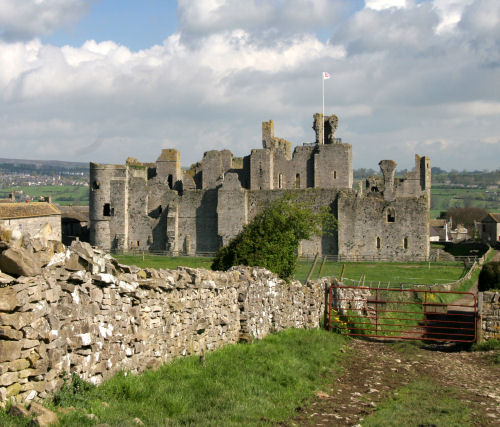
This is the wonderful Middleham Castle at Middleham in Wensyldale, Yorkshire. Once the home of King Richard the Third, it is a wonderful place. I love to visit whenever I can. Once inside the grounds you can feel an atmosphere. I always experience a warm feeling when I am there.

When I was young I thought Richard was the monster created by Shakespeare. Shortly Kevin Spacey will take on the role, and it is a good play and for me a bit of a hoot, but it has nothing to do with Richard. This is a play based on Tudor propaganda. The Tudors had much to lose by not besmirching Richard's reputation.

It was coming across Josehine Tey's wonderful book Daughter of Time that made me want to look at Richard more closely. I found out for example that he was not "hunchbacked" and that he was in love with his wife Anne Neville. That he was cultured and actually quite handsome.

I knew I wanted to write something about him and so my very first published novel " A Sprig of Broom" was born. (Soon to be published again as an e-book). In order to write the book I felt I had to visit Middleham and John and I set off one warm summer's day. It was magical. I was captivated. We often used to go and hire a cottage and stay there for a week or so. The wonder has never left me.

When I arrived home from my first visit my dad phoned. He asked where we had been and I thought he won't have heard of Middleham so I just said The Yorkshire Dales. He wanted me to be more specific so I told him. "Oh," says my dad,"Mark Johnson trains there." Ugh? Dad had two loves, cricket and horse racing and so knew where all the trainers of horses were based. Never underestimate a dad.

It is an added attraction a couple of times a day, to hear the horses' hooves on the cobbles as they go to the gallop on Middleham moor. Talk about atmosphere!

Many years after A Sprig of Broom, I returned to the theme of Richard and how good he was and so wrote Dangerous Enchantment. In this novel I took an entirely different tack but it is quite feasible. I am adding a review by fellow author John Lindermuth, for he explains perfectly the plot.

If you haven't been, do visit Middleham. Let me know if you are similarly entranced. Like me you might even wish that Richard had stayed there, safe and happy, in his beloved Yorkshire. I wonder what would have happened to England if that had been? Hm, might be a novel in that!

"A common belief, fostered by literature and film, is that Richard III, last of the Plantagenets, was a villain and may have been responsible for the murder of his own nephews. A number of writers and historians have advanced alternate theories, showing Richard as a just and honest ruler and attributing the deaths of the princes to others or dismissing it as a vile rumor spread by supporters of the dastardly Tudors.

Dangerous Enchantment offers another alternate theory in which the younger prince, Richard, Duke of York, survives and is protected by the lady in waiting of the king's wife and other loyal servants.

Kate accedes to Richard's command and marries Lord Mellor, going into hiding at his Yorkshire estate where the young duke is passed off as her stepson, scion of her husband. After Richard and Mellor are killed at Bosworth, Kate and her ward hope to escape to Burgundy with other loyalists.

But, before they can do so, Efan Caradoc, a Welsh supporter of the Tudor, arrives with his retinue and inform them he has been awarded the property of her deceased husband. The bastard son of a kitchen wench, Caradoc and Kate clash at first. Eventually both succumb to love, which sets the stage for other dangerous conflicts.

As a supporter of the good Richard theory, I was intrigued by Margaret Blake's version which offers captivating characters, an action-packed plot with plenty of twists and suspense, including a reasonable explanation for the fate of the younger Richard. Throw in the spicy romantic development and you've got a sure winner."

Sunday, February 20, 2011

George II and Caroline of Ansbach - A Love Match


By: Stephanie Burkhart
My story in the Cupid Diaries is one that is close to my heart – that of George II and Caroline of Ansbach. It's one of the first historical romances I've ever read and it really inspired the love I have for historical fiction.

I discovered this interesting couple back in 1988 when someone sent me a book called "Queen in Waiting" by Jean Plaidy in a care package. While I was waiting to take the Duty Train to Berlin, I sat down at a German Café and decided to give the story a try.

I loved it!

Jean Plaidy is a pen name for Victoria Holt and Victoria Holt was one of my favorite Romantic Gothic authors. I had no idea she did historical fiction, but she totally enthralled me with George and Caroline's story.

Historically, George and Caroline were a love match – a love match during a time when love matches were frowned upon.

George's father was George I of England, but before he ascended to the kingship, he was Elector of Hanover and his marriage was arranged. He couldn't stand his bride, Sophia Dorethra of Celle. He did his duty by her, had two children, then ignored her. She said what was good for the goose was good for the gander and CHEATED ON HIM. Well, George would not be cuckolded. He sent a young and vivacious woman to the tower. She grew old and died in that tower. George II was only a boy when it happened, but it left a mark on him.

When it came time for his son to marry, George I wanted George II to be in love with his wife. Surprising considering the times, but not so surprising considering what he went through in his marriage. His mother, The Dowager Electress Sophia suggested Caroline of Ansbach.

Caroline grew up in the small Baravian town of Ansbach. She was orphaned by ten and went to live with her mother's friend, Sophia Charlotte, the Electress of Prussia. Sophia Charlotte was the Dowager Electress's daughter. Caroline loved living with Sophia Charlotte. She grew up in a sophisticated court and one of her best friends was a philosopher, Liebnez.

Sophia Charlotte was on her way to Hanover to arrange the marriage of Caroline and George II when she died. George and Caroline seemed destined to never met.

The Dowager Electress whispered into her son's ear. Why not have George II marry Caroline? George I liked the idea, but wanted his son to be in love with his wife. He sent George II to Ansbach in disguise to meet Caroline and to see if a love match could be made. After all, his son had faults. He was short, short tempered, and a nag. Caroline was reputed to be beautiful, mild mannered, and quick-witted.

George was honored to be courting Caroline – even in secret. After all, she had refused the heir to the Spanish throne. If she was good enough for a king, well, she was a prize to have indeed. When he met her, the sparks flew on both sides and he realized it was more than pride – it was love.
They went on to marry and had 9 children. George I was offered the British throne and he accepted. George and Caroline became the Prince and Princess of Wales. Caroline was the FIRST Princess of Wales since Katherine of Aragon back in 1501.

Eventually, George II took mistresses. Initially Caroline was distressed. Wasn't she enough for him? They were a love match. Then she learned he only did it because he thought it was expected him to have a mistress. With that mind, she picked the mistresses out for him. Still, George loved her until the day she died. On her deathbed Caroline told him to marry again. He said he wouldn't. And he didn't.

Again, it was a story I admired because in a time when arranged marriages were the norm, George and Caroline were in love and then got married.

I hope you enjoy "Royal Pretender" in The Cupid Diaries.

Smiles
Steph

Saturday, February 19, 2011

Marguerite de Valois

Marguerite de Valois, known as Margot, was the youngest of the three daughters of King Henry II and Queen Catherine de Medici. Catherine was a widow by the time our story begins, her eldest son Francis II also dead. In addition, none of her three surviving sons enjoyed good health, so while in theory the crown was safe, there was no certainty they would all survive into old age, and these were risky times. France had been involved in civil war between the Catholics and the Huguenots for some years. As with all royal princesses, Margot was expected to bring political benefit with her marriage, and various suitors were considered and rejected. In the end the Queen Mother, who’d never showed much affection for this daughter, decided Margot should marry Henry of Navarre, a Huguenot, in order to bring peace to the realm.


Since the Valois were a Catholic House, this was something of a risky undertaking. Margot wasn’t at all pleased by the prospect. Henry was a third cousin whom she’d known from an early age, and she considered him something of a country bumpkin with garlic-tainted breath, and grubby feet from climbing mountains barefoot. There was some resistance from his mother, Jeanne d'Albret, but after she died, in somewhat suspicious circumstances, the wedding went ahead.


Days later the St. Bartholomew's Day Massacre took place where thousands of Huguenots were killed. Margot’s new husband was in danger of losing his head, and, as a Catholic married to a protestant and therefore accepted by neither, Margot too was far from safe.


But Margot was no average woman, rather one born before her time. She had long enjoyed a passionate love affair with Henri de Guise, and fully intended to maintain her right to continue with it, should her husband prove unfaithful, which naturally he did. Intrigue and scandal surrounded her at every turn, even when she was innocent. Margot soon took the view that she might as well live life to the full, and match her husband, affair for affair.

Both her brothers, first the half mad Charles IX, and then the bi-sexual Henri Trois with his mignons, and pet dogs and monkeys, made furious attempts to control her. Admittedly with very little success, but certainly caused her considerable grief. Henri frequently accused his sister of licentious behaviour, despite being far more guilty of that charge himself. He behaved like a rejected lover, jealous of the least attention she paid to any other man. He was even jealous of her love for their younger brother, Alençon, accusing the pair of plotting against him. It was almost as if he worked on the principle that if he could not have her, then no one else should. He kept her a virtual prisoner in the Louvre for four years, and throughout that time Margot lived in fear of her life while recklessly flouting convention as far as she dare. Somehow she had to save her husband's life, help him to escape, and then follow him to safety. A task fraught with danger.


This early part of Margot's life is told in my book Hostage Queen, which is out now in paperback, and as an ebook.

Click on Amazon for more details.

Or for the US edition, click here:

Thursday, February 17, 2011

Regency Hygiene, or the Lack Thereof, Part I


Regency England was a dirty place--and not only because of the large amount of horse manure around. Although the proverb "cleanliness is next to godliness" was known at this time, its meaning was different from today's interpretation.

For most of the era, cleanliness meant the daily washing of hands, face, and neck and wearing a clean shirt (for men), or a clean chemise (for women). The notion of immersing the entire body in water was anathema in Western Europe, and had been for the previous several hundred years.

Such an attitude did not exist in the ancient world. In the days of the Roman Empire, everyone--men, women and children, free and enslaved--visited the public baths every day. The Romans built baths in every corner of their far-flung empire. Even chilly Britannia, at the outer edge of their rule, had baths. Aquae Sulis (The Waters of the Goddess Sulis), now known as Bath, pictured right, received its Roman name from the hot springs located there.

As the Empire waned, so did its legacy, including baths and bathing. Public baths acquired the seedy reputation of encouraging licentiousness, although they remained fixtures in European life for centuries after Rome's demise.

The death of bathing occurred as a result of another death--the Black Death.

The Black Death (bubonic plague) was the worst pandemic the western world has ever seen. 30-60% of fourteenth-century Europe's population perished in agony due to this scourge. Panicked physicians, unaware that fleas transmitted the terrible disease, made a frantic search for any method of prevention.

The standard explanation blamed the planets for causing noxious vapors to rise from the earth and enter the body through the lungs. A new theory arose that skin softened by hot water became porous and provided the infection another entry. In terror for their lives, people stopped bathing. Bath houses fell into disrepair.

From the Black Death to the Regency, Western Europe grew dirtier and dirtier. Clothing, often tightly woven as another barrier to disease and made of hard-to-clean materials such as wool and silk, went unlaundered. The rich wore strong perfume to mask the often-overpowering stench of their neighbors' unwashed bodies. The poor just stank. Lice and fleas were rampant on everyone, regardless of class. The title of this 1638 Georges De La Tour painting is Woman Catching A Flea.

Dirtiness reached its peak--or nadir--in the Georgian era. By the time of the Regency, England had begun to clean up its act. The single person who was most influential in the resurgence of personal cleanliness was George "Beau" Brummell.

Next time—Beau Brummell.

Thank you all,
Linda
Linda Banche
Welcome to My World of Historical Hilarity!
http://www.lindabanche.com

Monday, February 14, 2011

I'm delighted to be part of the launch of Embrace Books with my Georgian Romance - The Reluctant Marquess


ISBN: 9781844718425

Salt Publishing Buy link: http://www.saltpublishing.com/ebooks/reg
Amazon Kindle Buy Link: http://www.amazon.com/The-Reluctant-Marquess-ebook/dp/B004NBY2EW/ref=sr_1_1?ie=UTF8&m=A24IB90LPZJ0BS&s=books&qid=1297546064&sr=1-1

Author website: http://www.maggiandersenauthor.com//


Blurb:

A country-bred girl, Charity Barlow never expected to become a Marchioness. Nonetheless, she is determined to make her marriage of convenience into the ton work. Yet despite the strong attraction between them, and Charity’s bold attempts at intimacy, the rakish Lord Robert does not believe a husband should be in love with his wife. Can she ever make him love her?

Excerpt:

The footman knocked on a solid oak door.

‘Enter.’

She stepped with trepidation into the room to be embraced by warmth. A fire blazed in the baronial fireplace where a liver-spotted spaniel lifted its head to study her. After a thump of a tail, its head sank to its paws again, lulled back to sleep by the heat. Above the fireplace, the painting of a hunting scene featured several dogs. Two tall china spaniels flanked the fireplace mantel. The heavy oak beams across the ceiling, and walls covered floor to ceiling in shelves of tomes made the room seem snug. Charity rushed over and crouched on the Oriental rug beside the animal, giving it a pat. The dog’s tail thumped harder. ‘You’re a nice fellow, aren’t you?’ Her stiff cold muscles loosened, and the icy pit at the base of her stomach began to thaw. Maybe she could be happy here. She loved dogs.

‘Welcome to Castle St. Malin.’

A man rose from behind a massive mahogany desk strewn with papers in the corner of the room. He crossed the room to greet her. He was not her godfather. She caught her breath. He was tall, his dark hair drawn back in a queue, and there was something of the marquess’ haughty demeanour about his handsome face, but she doubted he’d yet reached thirty.

‘Thank you.’ Charity could only stare at his attire, her gaze locked on his gold silk waistcoat as he bowed before her. He was in mourning, for black crepe graced the sleeve of his emerald green coat. With a sense of foreboding, she curtseyed on wobbly knees. ‘Where is the marquess, if you please?’ She looked around hoping her godfather might pop out of somewhere, but the room was otherwise empty.

‘I am the Marquess of St. Malin. My uncle passed away a short time ago.’

‘Oh. I’m so sorry.’ What she feared was true. Charity had an overwhelming desire to sit and glanced at the damask sofa.

He reacted immediately, taking her arm and escorting her to a chair. ‘Sit by the fire. You look cold and exhausted.’ He turned to the footman. ‘Bring a hot toddy for Miss Barlow.’

Charity sank down gratefully, her modest panniers settling around her.

‘I find the staff here poorly trained,’ he said. ‘I don’t know what my uncle was about.’

‘Why did you send a carriage for me?’ she asked, leaning back against the sofa cushions. ‘I wouldn’t have come had I known.’

‘I thought it best to sort the matter out here and now.’ He rested an elbow on a corner of the mantel and stirred the dog with a foot. ‘Shame on you, Felix. You might accord Miss Barlow a warm welcome.’ He looked at her. ‘My uncle’s dog; he’s mourning his master.’ He raised his brows. ‘Notice of my uncle’s passing appeared in The Daily Universal Register.’

‘We don’t get that newspaper in my village.’

‘You don’t? I wasn’t aware of you until the reading of the will. Then I learned of your parents’ death from my solicitor. I’m very sorry.’

‘Thank you. I’m sorry, too, about your uncle.’

‘My uncle fell ill only a few months ago. He rallied and then …’ The new marquess’ voice faded. He sighed and stared into the fire.

‘You must have been very fond of him,’ Charity said into the quiet pause that followed. Though, if she were honest, she felt surprise that the cool man she remembered could have provoked that level of affection.

He raised his eyes to meet hers and gave a bleak smile. ‘Yes, I was fond of him. He always had my interest at heart, you see.’ He sat in the oxblood leather chair opposite and rested his hands on his knees. ‘I am his acknowledged heir, and the legalities have been processed. I’ve inherited the title and the entailed properties. The rest of his fortune will pass to another family member should I fail to conform to the edicts of his will.’

'His will?’ Charity gripped her sweaty hands together, she couldn’t concentrate on anything the man said. Her mind whirled, filled with desperate thoughts. With her godfather dead, where would she go from here? Her heart raced as she envisioned riding off along the dark cliffs to join a theatre troupe, or become a tavern wench.

‘This must be difficult for you to take in, and I regret having to tell you tonight before you have rested. But I’m compelled to move quickly as you have no chaperone and have travelled here alone …’

She raised her chin. ‘There was no one to accompany me.’ She would not allow him to make her feel like a poor relation, even though she was quite definitely poor. And alone. She hated that more than anything. What had her godfather left her? She hoped it would allow her some measure of independence and wasn’t just a vase or the family portrait.

The footman entered, carrying a tray with a cup of steaming liquid. Charity took the drink and sipped it gratefully. It was warming and tasted of a spicy spirit. She found it hard to concentrate on his words, as her mind retreated into a fog and her eyes wandered around the room. She finished the drink, which had heated her insides, and allowed her head to loll back against the cushions. Her gaze rested on her host, thinking he would be handsome if he smiled. She was so tired, and the warmth of the fire made her drowsy. What was he saying?

‘It’s the best thing for both of us, don’t you agree?’

She shook her head to try and clear it. ‘I’m sorry, what did you say?’

He frowned. ‘The will states we must marry. Straightaway, I’m afraid.’

‘I … What? I’m to m-marry you?’ Placing her cup down carefully on the table she struggled to her feet, fighting fatigue and the affects of whatever it was she’d just drunk. Smoothing her gown, she glanced at the door through which she intended to depart at any moment. ‘I have no intention …’

His lips pressed together in a thin line. ‘I know it’s perplexing. I didn’t intend to wed for some years. I certainly would have preferred to choose whom I married, as no doubt would you.’

Her jaw dropped. What kind of man was this? She had been raised to believe that marriage was a sacred institution. He made it sound so … inconsequential. She stared at him. ‘The will states I must marry you?’

‘Yes, that’s exactly what it states.’ He rose abruptly with a rustle of silk taffeta and moved closer to the fire. She wondered if he might be as nervous as she. ‘Unless I’m prepared to allow my uncle’s unentailed fortune go to a distant relative. Which I am not. As I have said.’ His careful tone suggested he thought her a simpleton. Under his unsympathetic gaze, she sank back down onto the sofa. ‘You are perfectly within your rights to refuse, but I see very few options open to you. As my wife, you will live in comfort. You may go to London to enjoy the Season. I shall give you a generous allowance for gowns and hats, and things a lady must have.’ His gaze wandered over her cream muslin gown, and she placed a hand on the lace that disguised the small patch near her knee. ‘What do you say?’

She tilted her head. ‘I shall receive an allowance? For gowns, and hats, and things a lady must have.’

‘Exactly,’ he said with a smile, obviously quite pleased with himself. ‘I see we understand each other perfectly. So … do you agree?’

What was wrong with this man? Slowly, Charity released a heavy sigh. She could barely contemplate such a thing as this, and yet he acted as though he’d solved all the problems of the world with fashion accessories. She had hoped for a small stipend, but marriage! And to a complete stranger. She couldn’t! Not for all the gowns and hats on earth. She straightened up in her chair and lifted her chin. Her words were clipped and precise, and she hoped beyond hope he would accept her decision gracefully. ‘I say no, Lord St. Malin.’

‘No? Really?’

‘Yes, really.’

‘How disappointing,’ he said quietly.

She gulped as his heavy-lidded eyes continued to study her from head to foot. She was uncomfortably aware that the mist had sent her hair into a riot of untidy curls, and she smoothed it away from her face with both hands as she glanced around the room. She tucked a muddy shoe out of sight beneath her gown and then forced herself to meet his gaze. Might he like anything of what he saw? Her father loved that she had inherited her mother’s tiny waist, and she thought her hands pretty. His lordship’s gaze strayed to her breasts and remained there rather long. She sucked in a breath as her heart beat faster. When their eyes met did she detect a gleam of approval? It only made her more nervous.

In honour of the occasion, please enjoy excerpts from my top 12 favorite Love Poems

1. Sonnet 116 - William Shakespeare

Let me not to the marriage of true minds

Admit impediments. Love is not love

Which alters when it alteration finds,

Or bends with the remover to remove

Oh no! it is an ever-fixed mark,

That looks on tempests and is nevr shaken,

It is the star to every wandering bark,

Whose worth's unknown, although his height be taken.


2. Love One Another - Kahlil Gibran

Love one another, but make not a bond of love

Let it rather be a moving sea between the shores of your souls.

Fill each other's cup, but drink not from one cup.

Give one another of your bread, but eat not from the same loaf.


3. Meeting at Night - Robert Browning

Then a mile of warm sea-scented beach;

Three fields to cross till a farm appears;

A tap at the pane, the quick sharp scratch

And blue spurt of a lighted match,

And a voice less loud, thro' its joys and fears,

Than the two hearts beating each to each!


4. My River - Emily Dickinson (complete)

My river runs to thee.

Blue sea, wilt thou welcome me?

My river awaits reply.

Oh! Sea, look graciously.

I'll fetch thee brooks

From spotted nooks.

Say, sea,

Take me!


5. Love's Philosophy - Percy Bysshe Shelley

The fountains mingle with the river,

And the rivers with the ocean;

The winds of heaven mix forever

With a sweet emotion;

Nothing in the world is single;

All things by a law divine

In another's being mingle--

Why not I with thine?


6. Maud - Alfred, Lord Tennyson

COME into the garden, Maud,

For the black bat, Night, has flown,

Come into the garden, Maud,

I am here at the gate alone;

And the woodbine spices are wafted abroad,

And the musk of the roses blown.


For a breeze of morning moves,

And the planet of Love is on high,

Beginning to faint in the light that she loves

On a bed of daffodil sky,

To faint in the light of the sun she loves,

To faint in his light, and to die.


7. Annabelle Lee - Edgar Allan Poe

It was many and many a year ago,

In a kingdom by the sea,

That a maiden there lived whom you may know

By the name of ANNABEL LEE;--

And this maiden she lived with no other thought

Than to love and be loved by me.


8. Bright Star, Would I Were Steadfast as Thou Art - John Keats

Bright star, would I were steadfast as thou art

Not in lone splendour hung aloft the night,

And watching, with eternal lids apart,

Like nature's patient sleepless eremite,

The moving waters at their priestlike task

Of pure ablution round earth's human shores,

Or gazing on the new soft-fallen mask

Of snow upon the mountains and the moors;

No yet still steadfast, still unchangeable,

Pillow'd upon my fair love's ripening breast,

To feel for ever its soft fall and swell,

Awake for ever in a sweet unrest,

Still, still to hear her tender-taken breath,

And so live ever or else swoon to death.


9. To His Coy Mistress - Andrew Marvell

Now therefore, while the youthful hew

Sits on thy skin like morning glew,

And while thy willing Soul transpires

At every pore with instant Fires,

Now let us sport us while we may;

And now, like am'rous birds of prey,

Rather at once our Time devour,

Than languish in his slow-chapt pow'r.

Let us roll all our Strength, and all

Our sweetness, up into one Ball:

And tear our Pleasures with rough strife,

Thorough the Iron gates of Life.


10. Troilus and Criseyde  - Geoffrey Chaucer

To His Coy Mistress by Andrew Marvell

The double sorwe of Troilus to tellen,
That was the king Priamus sone of Troye,

In lovinge, how his aventures fellen

Fro wo to wele, and after out of Ioye,

My purpos is, er that I parte fro ye.
Thesiphone, thou help me for tendyte

Thise woful vers, that wepen as I wryte!


11. The Love-Song of J Alfred Prufrock by TS Eliot

And would it have been worth it, after all,

After the cups, the marmalade, the tea,

Among the porcelain, among some talk of you and me,

Would it have been worth while,

To have bitten off the matter with a smile,

To have squeezed the universe into a ball

To roll it toward some overwhelming question,

To say: “I am Lazarus, come from the dead,

Come back to tell you all, I shall tell you all”—

If one, settling a pillow by her head,

Should say: “That is not what I meant at all.

That is not it, at all.”


12. John Donne's The Flea

Marke but this flea, and marke in this,

How little that which thou deny'st me is;

Me it suck'd first, and now sucks thee,

And in this flea our two bloods mingled bee;

Confesse it, this cannot be said

A sinne, or shame, or losse of maidenhead,

Yet this enjoyes before it wooe,

And pamper'd swells with one blood made of two,

And this, alas, is more than wee would doe.


If you have a favourite love poem you'd like to mention in the comments you may win a copy of the e-book.